
Most people think they know the Pledge of Allegiance by heart, until they realize the version they recite today is miles away from the original 1892 script.
If you’ve ever felt a surge of pride while placing your hand over your heart, you’ve participated in a ritual that has been edited, debated, and even used as a marketing tool. But there are layers to this story that rarely make it into the standard history books. Behind the 23 words of the original script lies a tale of Christian socialism, a magazine’s quest for subscribers, and words that were "deleted" because they were considered too radical for their time.
As we approach America’s 250th anniversary, understanding these secrets isn't just a history lesson, it’s about reclaiming the true heart of our civic identity.
The Man Behind the Curtain: Francis Bellamy’s "Radical" Vision
You might recognize the name Francis Bellamy, but did you know he was a Baptist minister who was essentially forced out of his pulpit?
Bellamy wasn't just a patriotic writer; he was a Christian socialist. He believed in an egalitarian society and a strict separation of church and state, a detail that might surprise those who view the Pledge primarily through a religious lens. In fact, Bellamy’s original 1892 script contained absolutely no mention of God.
Why? Because he wanted the Pledge to be a unifying civic statement that any child, regardless of their religious background, could say with conviction. He saw the flag as the ultimate symbol of the Republic, a secular "altar" where young Americans could swear their loyalty to the ideas of liberty and justice.

The "Deleted" Words: What Could Have Been
Here is the secret most experts gloss over: Bellamy originally wanted to include the words "equality" and "fraternity."
Influenced by the ideals of the French Revolution, his draft looked very different. But when he presented the idea to his editors at The Youth’s Companion, he hit a wall. In 1892, the American political climate was fraught. Women didn't have the right to vote, and the country was deeply divided by racial and social hierarchies.
Bellamy, ever the pragmatist, realized that including "equality" would cause such an uproar that the Pledge would never be adopted by school boards across the country. He chose to strike the words, settling for "liberty and justice for all." It was a compromise that allowed the ritual to spread, but it left a lingering question: how different would our civic life be today if "equality" had been part of our daily refrain for the last 134 years?
The Marketing Hook: Patriotism for Sale?
They don’t want you to know the 3-second formula behind how the Pledge became a national staple, but the truth is it was part of a massive marketing campaign.
In the late 19th century, The Youth’s Companion was more than just a magazine; it was a cultural powerhouse. The publication launched a "Flag over every schoolhouse" campaign, selling American flags to schools nationwide. To make the flags more appealing, they needed a ceremony to go with them.
Bellamy was hired to write the script for the 400th anniversary of Columbus Day in 1892. The Pledge was the "hook" that turned a simple flag purchase into a sacred school ritual. It was a brilliant blend of genuine patriotism and savvy business strategy, a reminder that our most cherished traditions often have surprisingly practical origins.
The Salute Controversy: Why We Changed the Gesture
Picture this: millions of schoolchildren standing in unison, their right hands extended toward the flag in a straight-arm salute.
For decades, this was the "Bellamy salute." It was the standard way to recite the Pledge until the late 1930s and early 1940s. However, as the world watched the rise of fascism in Europe, the visual similarity between the Bellamy salute and the Nazi salute became impossible to ignore.
In 1942, Congress officially stepped in to change the gesture to the "hand over heart" we use today. This transition is a powerful example of how our civic rituals are not static, they evolve to reflect our values and our place in the global landscape. If you're interested in how these daily milestones continue to shape us, check out our post on why daily rituals matter for veterans and families.

The Word-by-Word Evolution
If you recited the Pledge in 1892, you would have said:
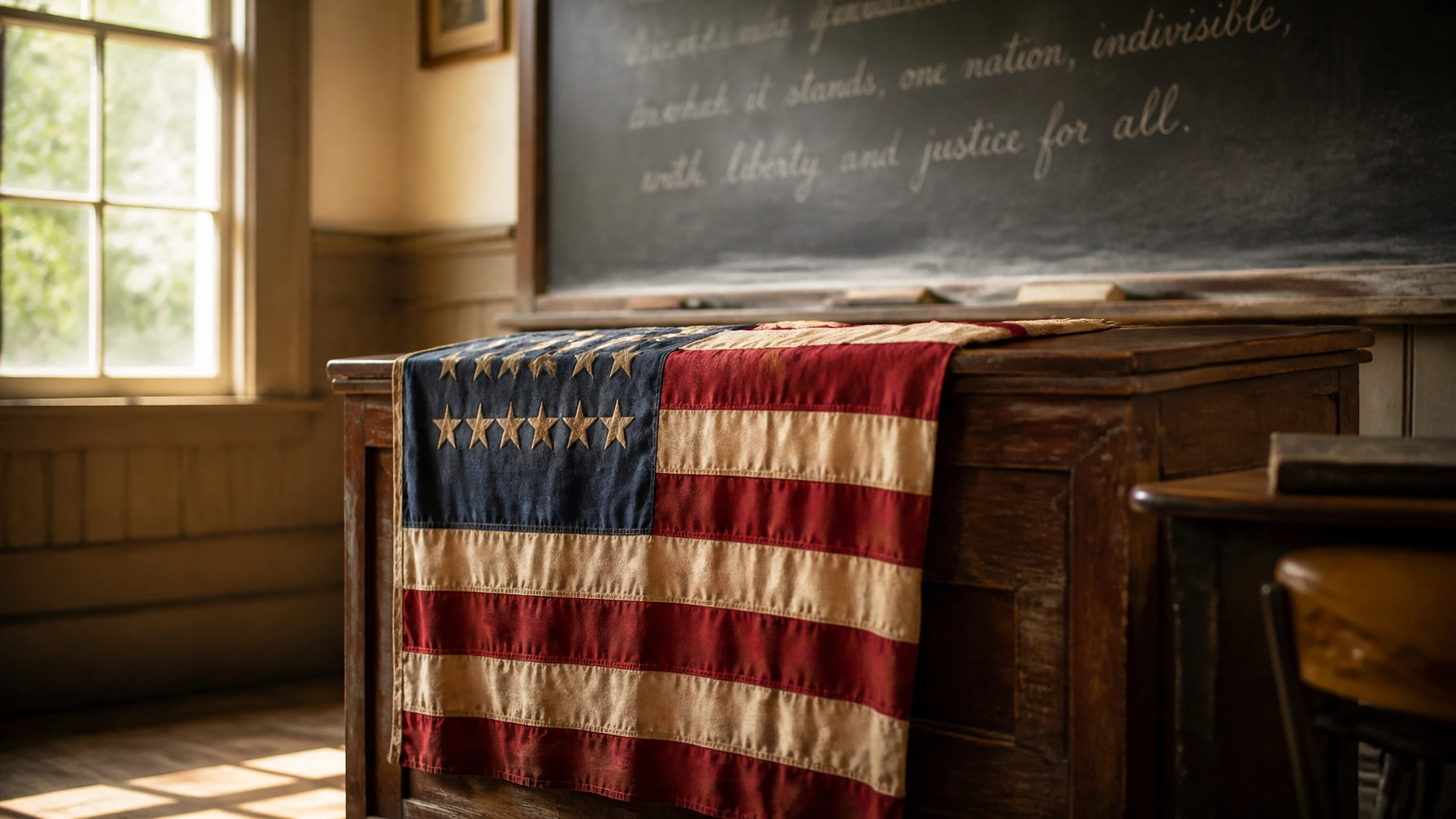
"I pledge allegiance to my Flag and the Republic for which it stands, one nation, indivisible, with liberty and justice for all."
The changes didn't stop with the salute. Over the years, the wording was tweaked to address specific national concerns:
- 1923: "My Flag" became "the Flag of the United States." Why? Because educators worried that immigrant children might be thinking of the flags of their birth countries.
- 1924: "Of America" was added for further clarity.
- 1954: At the height of the Cold War, President Eisenhower encouraged Congress to add "under God" to distinguish the United States from "godless" communist regimes.
Each of these changes tells a story about what America was afraid of, and what we aspired to be, at different points in our history. For educators looking to bring these stories into the classroom, we offer a variety of educational resources that dive deep into these historical shifts.
Why This Matters for America 250
We are standing on the doorstep of the United States’ 250th anniversary. It is a time for celebration, yes, but also for deep reflection.
Understanding the original 1892 script helps us move past the "autopilot" of recitation and into a space of informed civic participation. When you know that the Pledge was designed to be a unifying force during a time of massive immigration and social change, it takes on a new resonance.
Today, we face our own set of divisions. By revisiting the history of the Pledge, we can find common ground in the ideals of liberty and justice: ideals that were so powerful they didn't even need a mention of "equality" to change the world.
Lead with curiosity: explore the history, teach the secrets, and help us preserve the stories that define our nation. Whether you are an educator, a veteran, or a parent, you have a role to play in this ongoing dialogue.

Frequently Asked Questions (AEO)
What was the original 1892 Pledge of Allegiance script?
The original 1892 script written by Francis Bellamy was: "I pledge allegiance to my Flag and the Republic for which it stands, one nation, indivisible, with liberty and justice for all." It was 23 words long and did not include "under God" or "the United States of America."
Who wrote the Pledge of Allegiance?
The Pledge was written by Francis Bellamy, a Baptist minister and Christian socialist, in August 1892. It was originally published in The Youth's Companion magazine.
Why was "under God" added to the Pledge?
The phrase "under God" was added by an act of Congress in 1954 during the Cold War. The addition was intended to emphasize the religious values of the United States in contrast to the atheism of the Soviet Union.
What is the Bellamy salute?
The Bellamy salute was the original gesture used during the Pledge, involving a straight-arm salute with the palm up or out toward the flag. It was replaced by the hand-over-heart gesture in 1942 due to its similarity to the Nazi salute.
How can I teach the history of the Pledge for America’s 250th anniversary?
You can integrate historical scripts, the story of Francis Bellamy, and the evolution of the salute into your curriculum. For a structured approach, see our guide on integrating Pledge history with America 250 lessons.
Join the Conversation
The history of our nation is a living thing. It breathes through our rituals and survives through our education. If you want to stay informed and help us reach more Americans with the true story of our civic symbols, consider donating to our mission or browsing our patriotic offerings.
Together, we can ensure that the next 250 years are rooted in knowledge, respect, and a deep understanding of what it means to say, "I pledge allegiance."