
Most people think the Pledge of Allegiance is a static relic passed down directly from the Founding Fathers: until they realize it was actually written by a socialist minister in the 1890s who was looking to sell magazines.
Does that shock you? It should.
As we march toward America’s 250th anniversary in 2026, understanding the DNA of our national rituals is more than just a history lesson; it’s a requirement for anyone who calls themselves a patriot. I’m Dan Kost, and here at Pledge Allegiance, we believe that civic education isn't just about memorizing dates: it’s about understanding the "why" behind the "what."
When you stand up, put your hand over your heart, and recite those thirty-one words, you aren't just reciting a poem. You are participating in a living, breathing history that has been edited, debated, and legally challenged for over a century. Let’s dive deep into the secrets behind the words we say every day.
The Radical Minister Behind the Words
Picture this: The year is 1892. America is still healing from the scars of the Civil War. Millions of immigrants are flowing through Ellis Island. The country is desperate for a sense of unified identity.
Enter Francis Bellamy.
Bellamy wasn't a politician or a General. He was an ordained Baptist minister who had been kicked out of his Boston church for preaching "socialist" ideas that made his congregation uncomfortable. He landed a job in the marketing department of The Youth’s Companion, a popular family magazine.
His mission? Create a patriotic program for schools to celebrate the 400th anniversary of Christopher Columbus’s arrival in the Americas. He needed a "hook" that would get kids excited about the flag: and, let’s be honest, help sell more magazines.
What he created in a single August evening changed the fabric of American culture forever. But the version he wrote in 1892 isn't exactly what you’re saying today.

The Missing Word: Why "Equality" Was Left Out
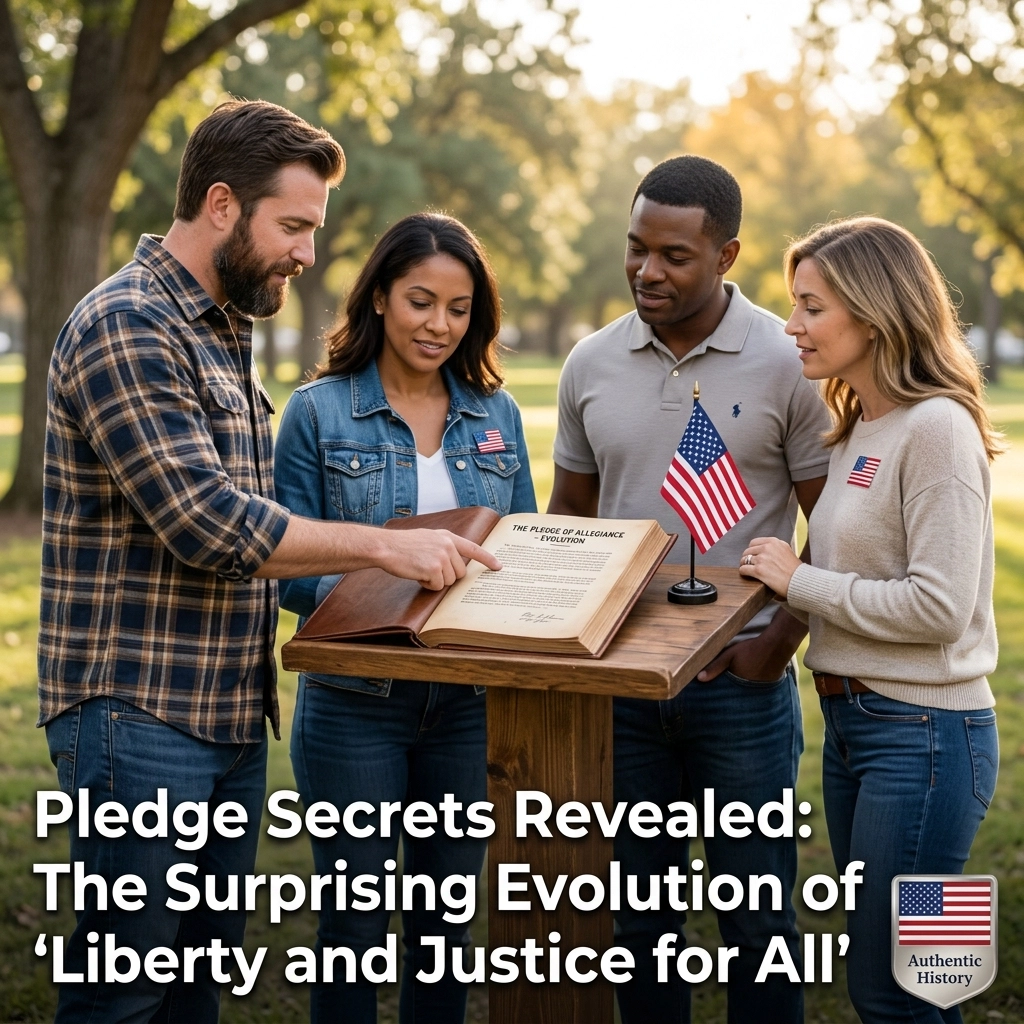
Here is a secret that usually gets left out of the history books: Bellamy originally wanted to include the word "equality" in the Pledge.
Think about that for a second. “With liberty, equality, and justice for all.” It has a nice ring to it, doesn't it? It aligns perfectly with the Declaration of Independence. So, why isn't it there?
Bellamy was a man of his time, but he was also a pragmatist. He knew that the 1890s were a period of intense social friction. The Reconstruction era had ended, Jim Crow laws were tightening their grip on the South, and women were still decades away from having the right to vote.
Bellamy realized that if he included the word "equality," the superintendents in the South and the traditionalists in the North would reject the Pledge entirely. He chose to omit the word to ensure the Pledge could achieve national adoption. He sacrificed a core ideal for the sake of national unity: a trade-off that highlights the complicated nature of American progress.
The Original 22 Words
When the first group of school children recited the Pledge on October 21, 1892, they said this:
"I pledge allegiance to my Flag and the Republic for which it stands, one nation, indivisible, with liberty and justice for all."
Notice the difference? There was no mention of "the United States of America," and there was definitely no "under God."
The phrase "my Flag" was intentional. It was meant to be universal. However, by the 1920s, the National Flag Conference grew concerned. They worried that immigrant children might be thinking of the flags of their birth countries when they said "my Flag." To clear up any confusion, the wording was changed to "the Flag of the United States of America."
If you want to understand how these subtle changes reflect our changing national identity, you should check out our deep dive on why America's 250th anniversary matters for civic education. It’s the perfect time to reset how we teach these concepts to our kids.
The Cold War and the "Under God" Addition
If you ask most veterans or educators about the most controversial part of the Pledge, they’ll point to the phrase "under God." But many are surprised to learn that this phrase wasn't added until June 14, 1954: Flag Day.
Why then? Two words: Communism and Eisenhower.
During the height of the Cold War, the United States was locked in an ideological battle with the Soviet Union. The Soviets were officially atheist. To draw a sharp line between "God-fearing Americans" and "Godless Communists," President Dwight D. Eisenhower signed a law officially adding those two words to the Pledge.
Eisenhower stated at the time: "In this way we are reaffirming the transcendence of religious faith in America's heritage and future; in this way we shall constantly strengthen those spiritual weapons which forever will be our country's most powerful resource in peace and war."
This turned the Pledge from a purely civic statement into a quasi-religious oath. It’s a shift that continues to spark legal debates in school boards and courtrooms across the country to this day.

Why This Evolution Matters to You
You might be wondering, "Dan, why does the history of these edits matter? I just want to show my love for my country."
It matters because the Pledge is a living ritual. It’s not a dusty document in a museum; it’s a promise we make to each other. When you understand that the Pledge has been edited to reflect the needs of the time: whether it was post-Civil War healing or Cold War defiance: you realize that we have a responsibility to keep those words meaningful today.
For educators, this is the ultimate "teachable moment." Don't just make your students stand up and drone the words. Teach them about the Baptist minister who wanted "equality" but settled for "justice." Teach them about the 1954 addition and the debate over the separation of church and state.
For veterans, the Pledge is a reminder of the "Republic for which it stands." You didn't fight for a piece of cloth; you fought for the idea of a nation that is indivisible.
Preparing for 2026: The 250th Milestone
We are rapidly approaching the Semiquincentennial: America’s 250th birthday. This isn't just a day for fireworks and BBQ. It’s a moment for a national "civic reset."
At Pledge Allegiance, we are on a mission to bring this history back into the spotlight. We want every classroom, every VFW hall, and every family dinner table to engage with what it actually means to be "one nation."
If you believe in the power of civic education, I encourage you to explore our offerings or even make a donation to help us get these educational materials into more schools. We need your help to ensure the next generation doesn't just say the words, but actually lives them.

Action Steps for Patriots
How can you take this information and make an impact in your community? Here are a few ways to start:
- Lead the Conversation: The next time you’re at a community meeting, share one of these "Pledge Secrets." Spark a discussion about what "Liberty and Justice for All" means in 2026.
- Educate the Youth: If you’re a parent or grandparent, sit down with your kids. Ask them what they think the words mean. Explain that "indivisible" means we’re all in this together, even when we disagree.
- Support Civic Education: Our schools are under pressure, and civic education often takes a backseat to standardized testing. Reach out to your local school board and ask how they are preparing for the 250th anniversary.
- Stay Informed: My daily letters are designed to give you the tools you need to lead your local community. You can find more about how these letters can change your leadership style here.
The Heart of the Message
At the end of the day, those thirty-one words are a mirror. They reflect who we were in 1892, who we were in 1954, and who we are today.
Bellamy’s original 22 words were a start. The additions and changes over the years are a testament to the fact that America is a work in progress. We are still striving for that "more perfect union."
When you say "with liberty and justice for all," you aren't describing a finished product. You are describing a goal. You are committing yourself to the hard work of making sure that justice isn't just for some, but truly for all.

Keep the fire of patriotism burning, stay curious about our history, and never stop pledging your allegiance to the ideals that make this country the greatest experiment in human history.
If you want to stay updated on everything we’re doing for the 250th anniversary, make sure to visit our blog regularly. We have a lot of exciting things coming, and I don't want you to miss a single update.
Let's make sure the next 250 years are even better than the last. See you out there!