
Most people think the Pledge of Allegiance has remained unchanged since the founding of our country, until they realize it’s actually been a living, breathing document that has evolved alongside our national identity for over 130 years.
Hey there, I’m Dan Kost, CEO of Pledge Allegiance. If you’ve spent any time in a classroom, at a VFW hall, or at a local community meeting, you’ve said these 31 words hundreds, maybe thousands of times. But how often do we stop to think about where they came from? As we rapidly approach America’s 250th anniversary, there’s never been a better time to master the history behind our national oath.
Understanding the "why" behind the "what" isn't just a history lesson: it's a way to reclaim our sense of unity. In fact, civic participation matters because understanding pledge history is key to America's 250th. Let’s dive deep into the story behind every phrase and see how a simple magazine promotion became the heartbeat of American patriotism.
The 1892 Origin: A Marketing Campaign with a Soul
Picture this: It’s 1892. The United States is preparing to celebrate the 400th anniversary of Christopher Columbus’s arrival in the Americas. A man named Francis Bellamy: a Baptist minister and a writer for a popular magazine called The Youth’s Companion: is tasked with creating something to spark a renewed sense of patriotism in the nation’s youth.
Bellamy didn’t just want a catchy slogan. He wanted a "formula of belief" that would bind a divided nation back together after the scars of the Civil War. He penned the original version in August of 1892, and it was published in the September 8th issue of the magazine.
Back then, it looked a little different:
"I pledge allegiance to my Flag and the Republic for which it stands, one nation, indivisible, with liberty and justice for all."

No "United States of America." No "under God." Just a raw, punchy commitment to the flag and the Republic. It was an instant hit. Within weeks, millions of school children were reciting it, and a national tradition was born.
The Evolution: Why We Changed the Words
If you’ve ever felt like history is static, the Pledge is here to prove you wrong. It has been officially amended twice since its inception.
1923: Clarifying the Commitment
By 1923, the National Flag Conference decided that "my Flag" was a bit too ambiguous. With so many immigrants coming to America’s shores, leaders wanted to ensure that everyone knew exactly which flag they were promising their loyalty to. They changed the phrasing to "the Flag of the United States." A year later, they added "of America" just to be crystal clear.
1954: A Spiritual Addition
The most famous change came during the height of the Cold War. In 1954, President Dwight D. Eisenhower encouraged Congress to add the words "under God." This wasn't just a religious move: it was a strategic one. It was meant to distinguish American democracy from the state-sponsored atheism of the Soviet Union. If you’re curious about the deeper details of this era, check out our guide on the 10 things you should know about the 1954 change.
Breaking It Down: Mastering the Meaning of Every Phrase
Now, let’s get into the "101" of it all. To truly master the Pledge, you have to understand the weight of the words you're speaking. Let's break it down phrase by phrase.
"I Pledge Allegiance"
This isn't just a polite "hello" to a piece of cloth. A "pledge" is a solemn promise: a vow. "Allegiance" means loyalty and devotion. When you start the Pledge, you are essentially saying, "I give my word that I am loyal to this cause." It’s an action verb that requires a commitment of the heart.
"To the Flag of the United States of America"
We aren't just saluting fabric; we are saluting what the fabric represents. The flag is a visual shorthand for our history, our sacrifices, and our collective future. By specifying "the United States of America," we acknowledge that our loyalty isn't to a king or a single person, but to a collective union of states.
"And to the Republic for which it stands"
This is where civic education gets real. We aren't a pure democracy where the majority can simply trample the minority on a whim; we are a Republic. This means we are governed by laws and represented by people we elect. The flag "stands" for this system: a system designed to protect the rights of the individual.

"One Nation"
Think about the time Bellamy wrote this. The Civil War was still a living memory for many. "One Nation" was a defiant stance against the idea that we could ever be split apart again. It’s a call for unity that is more relevant today than ever. In my daily CEO letters, I often talk about how unity is making a comeback, and it starts right here with this phrase.
"Under God"
Whether you view this through a theological lens or a historical one, these words signify that our rights don't come from the government. They come from a higher power (or "Nature's God," as the Founders put it). This means the government can't take those rights away because the government didn't grant them in the first place.
"Indivisible"
This word is a powerhouse. It means we cannot be divided. No matter how much we argue or how different our opinions might be, at the end of the day, we are one cohesive unit. It’s the ultimate "we’re in this together" statement.
"With Liberty and Justice for All"
This is the mission statement. Notice it doesn't say "liberty and justice for some" or "for those who agree with me." It says for all. It’s a goal we are constantly striving toward. It’s a reminder that our work as citizens is never truly finished.

Why Educators and Families Need This Knowledge
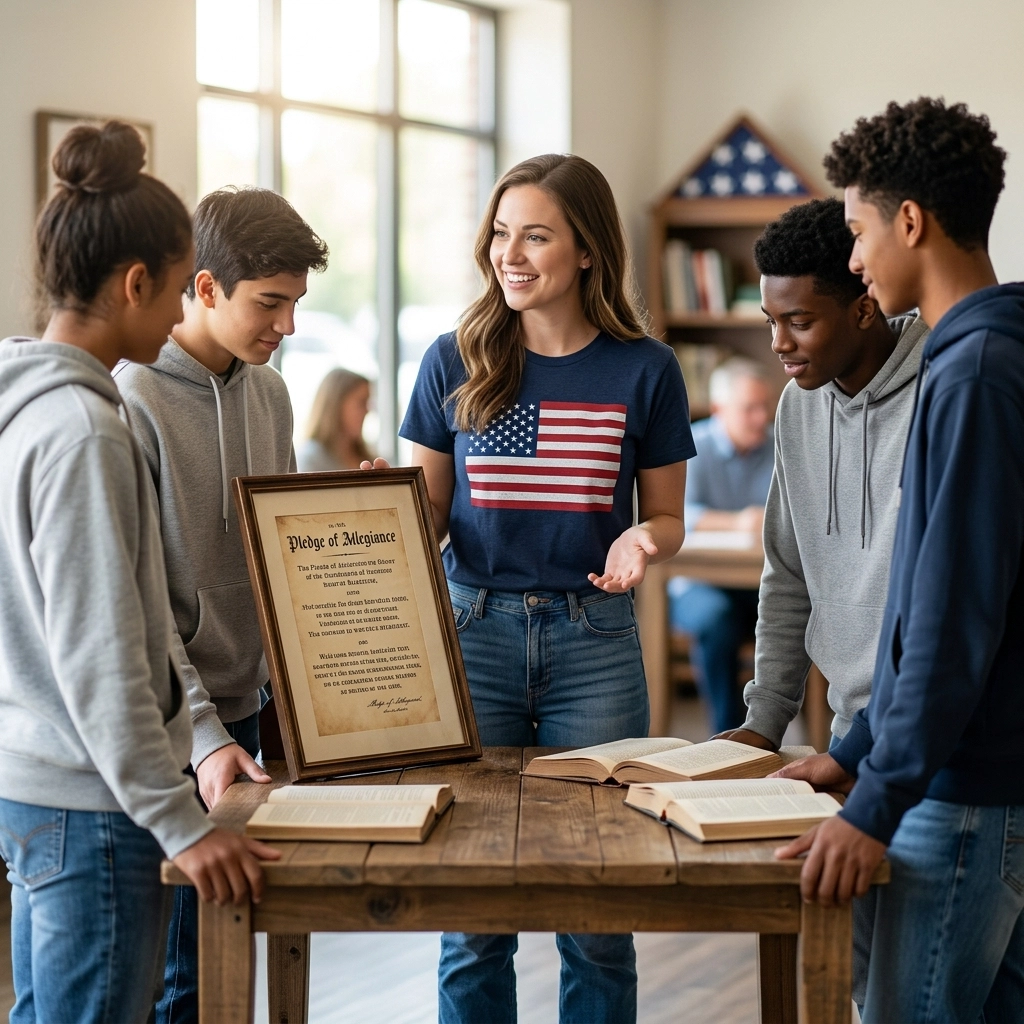
If you’re a teacher or a parent, you have a unique opportunity. When you lead a classroom or your kids in the Pledge, you aren't just reciting a poem. You are teaching them the fundamentals of civic education.
Mastering this history allows you to:
- Spark Curiosity: Instead of a rote morning routine, turn it into a discussion. Ask your kids, "What does it mean to be indivisible?"
- Reinforce Values: Use the phrases to talk about justice and what it looks like in their daily lives.
- Connect with Veterans: For our veterans, these words are often written in blood. Teaching kids the history of the Pledge helps them appreciate the service of those who protected the "Republic for which it stands."
Preparing for America’s 250th Anniversary
We are standing on the doorstep of a massive milestone. In 2026, our nation turns 250. This isn't just about fireworks and parades; it's about a national "gut check." Who are we? What do we stand for?
The Pledge is the perfect tool for this reflection. By mastering its history now, you’re preparing yourself and your community to celebrate our 250th with a deeper sense of purpose. We’ve put together an America's 250th 101 guide to help you get ahead of the curve.

Join the Movement
At Pledge Allegiance, we believe that a little bit of civic education goes a long way in healing the divides in our country. We’re more than just a non-profit; we’re a community of patriots who believe that our best days are still ahead of us.
If you found this guide helpful, I’d love for you to stay connected. Thousands of patriots are already reading my daily notes on how we’re reclaiming American unity. You can find out why everyone is talking about these daily CEO notes and join the conversation.
We also put out daily updates on civic milestones and veteran initiatives. If you want to stay in the loop, check out our latest press releases and program updates.
Mastering the Pledge is just the first step. Let’s keep moving forward, one phrase at a time, toward a future where "liberty and justice for all" isn't just a phrase we say: it's a reality we live.
Stay patriotic, my friends.
: Dan Kost, CEO, Pledge Allegiance