
Picture this: You're standing in front of your classroom, hand over heart, reciting words you've spoken a thousand times. The students around you mumble through the Pledge, their voices running on autopilot. Now what if I told you that every single phrase in those 31 words connects directly to the revolutionary ideas that sparked America's founding – and that 2026 is the perfect year to teach it?
As we celebrate America's 250th birthday this year, you have a once-in-a-generation opportunity to transform the Pledge of Allegiance from a rote recitation into a powerful lesson on the principles that built our nation. You don't need a history degree or fancy curriculum. You just need to understand the connections – and I'm about to show you exactly how to make them.
Why the 250th Makes This Moment Critical
You're living through a milestone that won't come again in your lifetime. America's 250th birthday isn't just another year – it's a turning point where we choose whether the next generation understands what makes this nation unique. The Pledge of Allegiance isn't outdated tradition. It's a compressed masterclass in American civics, and each phrase maps directly onto the ideas our founders risked everything to establish.
Let's break it down, phrase by phrase, founding ideal by founding ideal.
"I Pledge Allegiance" – The Principle of Voluntary Consent
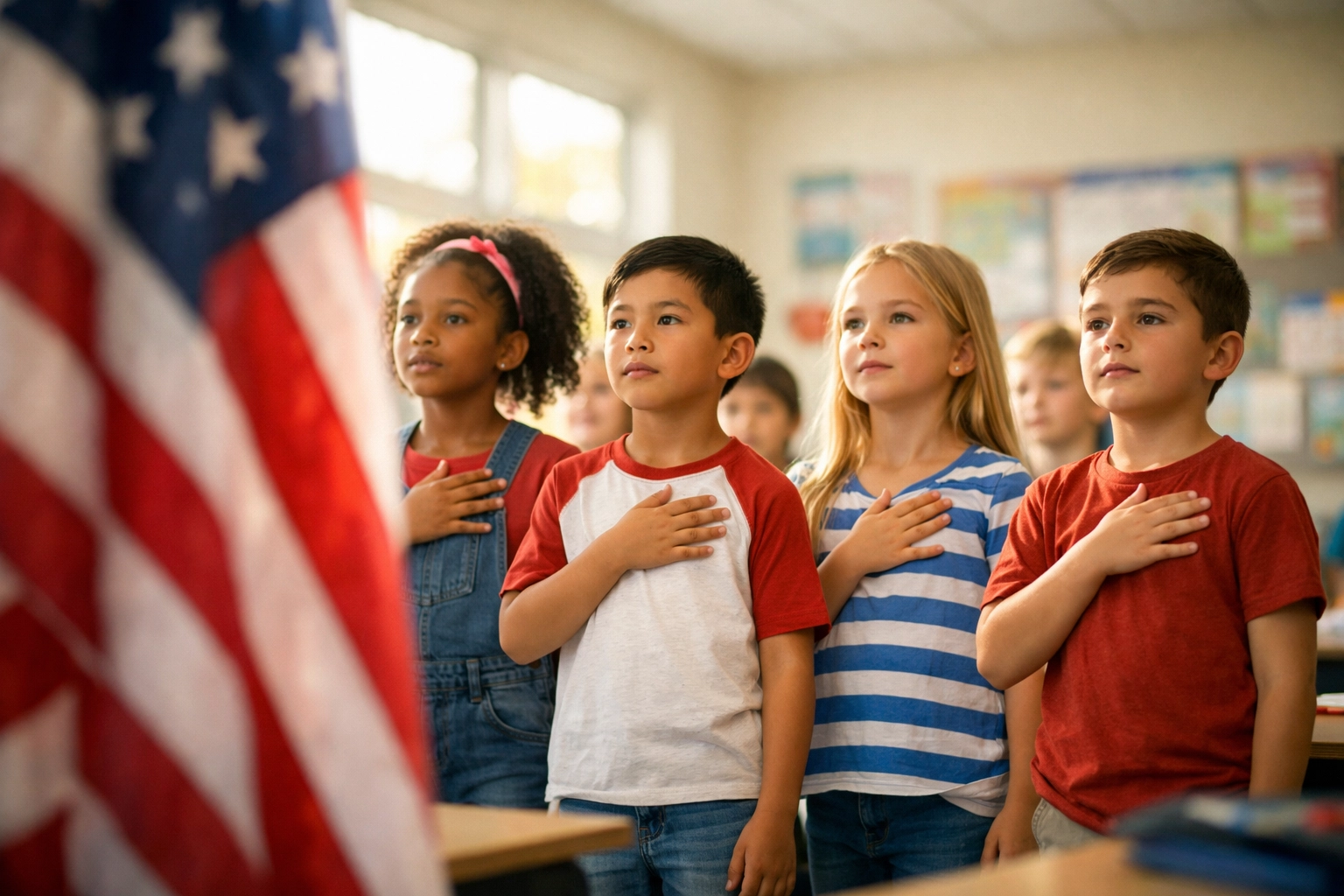
Start here: the very first words establish something radical. You're making a choice to pledge. The founders built America on the idea of consent of the governed – that legitimate government derives its power from the people's voluntary agreement, not from force or birthright.
When you help students understand they're choosing to pledge, you're teaching them about self-governance. The Declaration of Independence doesn't say governments force obedience – it says they derive "their just powers from the consent of the governed." That's what "I pledge" means. It's personal. It's voluntary. It's the foundation of republican government.
Teaching tip: Ask your students if anyone forced them to say the Pledge. The answer reveals everything about American freedom – even the freedom not to participate demonstrates the founding principle of individual liberty.
"To the Flag of the United States of America" – Symbols of Unity and Shared Identity
You're not pledging to a person, a king, or a political party. You're pledging to a symbol that represents all Americans. The founders deliberately rejected monarchy and created a system where loyalty belonged to shared principles, not powerful individuals.
The flag represents the rule of law – that we're governed by consistent principles, not the whims of whoever holds power. When you pledge to the flag, you're affirming that America is an idea, not just a place. That idea? Natural rights, equal protection, and government limited by written law.
Connect this to the Constitution – a written document that stands above any single leader. The founders knew that tyranny happens when people follow personalities instead of principles. The flag reminds us we're pledging to something bigger.
"And to the Republic for Which It Stands" – Republican Government vs. Pure Democracy
Here's where you can blow your students' minds: America isn't a pure democracy. It never was. You live in a constitutional republic, and that distinction matters enormously.
The founders studied history and saw that pure democracies often devolved into mob rule – where 51% could strip rights from the other 49%. So they created a republic: a system of representative government with built-in protections for individual rights and minority viewpoints. Think electoral college, bicameral legislature, and Bill of Rights.
When you say "republic," you're affirming the founding ideal of limited government – that even majority opinion can't override certain fundamental rights. You're teaching that popular passion must be filtered through deliberative institutions designed to protect liberty.

"One Nation" – E Pluribus Unum in Action
Before 1776, most people couldn't imagine large, diverse populations governing themselves. Kings ruled. Empires conquered. But the founders attempted something unprecedented: creating one nation from many distinct colonies, cultures, and interests.
"One nation" connects to the founding ideal that republican self-governance could work on a continental scale. It wasn't guaranteed – the Articles of Confederation nearly failed. But the Constitution created a federal system balancing state sovereignty with national unity.
You're teaching students that unity doesn't mean uniformity. America's founding ideal was that people with different backgrounds, beliefs, and interests could unite around shared principles of liberty and self-government. That's the miracle you're celebrating in the 250th year.
"Indivisible" – The Founding Commitment to Union
This word carries weight earned through blood. You can't understand "indivisible" without knowing the founders feared fragmentation would destroy the republican experiment. The Civil War later proved how costly division could be – and reaffirmed that the Union must be preserved to protect the founding ideals for all.
"Indivisible" teaches that liberty requires a strong enough union to protect it. You can't have individual rights if hostile powers or internal factions tear the nation apart. The founders understood that republican government needs both limited federal power and sufficient unity to survive.
When you emphasize "indivisible" in 2026, you're connecting students to the founding ideal that America's success depends on staying united around core principles, even when we disagree on everything else.
"With Liberty and Justice for All" – The Arc of Expanding Rights
Here's your crescendo. These final words connect to virtually every founding ideal: natural rights, individual liberty, equal protection under law, and the rule of law itself.
"Liberty" echoes the Declaration's promise of life, liberty, and the pursuit of happiness – the idea that you possess inherent rights no government can legitimately take away. "Justice" points to the Constitution's promise of due process and equal protection – that laws apply equally to everyone, regardless of status or power.
"For all" is the most revolutionary part. Yes, the founders' application was imperfect. But the ideal they articulated – that rights belong to all people equally – created the standard by which America has progressively expanded liberty. From abolition to women's suffrage to civil rights, every expansion of freedom has appealed to the founding ideals embedded in these words.
You're teaching students that America's story is one of gradually living up to principles we stated from the beginning. The 250th birthday is a moment to celebrate how far we've come – and to recognize the work of aligning reality with founding ideals continues.
Making It Real for the 250th Birthday
You now have the roadmap. Every phrase connects. Every word teaches. But here's the question: how do you make this stick with your students during America's 250th year?
Start by making it interactive. Don't just lecture about founding ideals – have students debate them, question them, apply them to current issues. Use the Pledge as your framework, then explore how these principles show up in the Constitution, the Bill of Rights, and the messy, glorious story of American history.
And here's the practical part: you don't have to build these lessons from scratch. Our Classroom Kit was designed specifically to help educators like you teach the Pledge with depth and meaning – perfect timing for the 250th. It includes guided activities, discussion prompts, and historical context that connects each phrase to America's founding story. You get ready-to-use materials that transform the Pledge from routine to revelation.

Your Role in the 250th Birthday Celebration
You're not just teaching history. You're participating in it. The students you teach this year will remember that during America's 250th birthday, someone showed them why the Pledge matters. Someone connected 31 words to 250 years of struggle, sacrifice, and success in the pursuit of liberty and self-governance.
The founding ideals aren't abstract philosophy – they're the operating system of American freedom. Natural rights. Republican government. Rule of law. Equal justice. Limited power. Individual liberty. Every phrase of the Pledge points to these principles. Every recitation is an opportunity to teach them.
As we celebrate this milestone birthday, you have the chance to ensure the next generation doesn't just memorize the Pledge – they understand it, they question it, they connect it to the revolutionary ideas that made America possible.
That's the gift you can give in 2026. That's how you honor 250 years of American self-governance. And that's how you help ensure the founding ideals continue shaping America for the next 250 years.
Make this 250th birthday count. Teach the connections. Inspire the conversations. Order your Classroom Kit today and give your students the tools to understand the Pledge – and the nation it represents – at the deepest level. Because the best birthday gift we can give America is a generation that truly understands what makes it exceptional.