
Most people think civic traditions are just dusty relics from a history book, until they realize how close we are to losing the very glue that holds our nation together. As we stand here on May 1, 2026, just a few short months away from America’s 250th birthday, we have to ask ourselves a tough question: Are we still a people who understand what it means to pledge?
If you’ve ever felt like the world is moving too fast and our shared values are slipping through our fingers, you aren’t alone. I’m Dan Kost, and at Pledge Allegiance, we see the data every day. We see the headlines. But more importantly, we see the opportunity. America’s Semiquincentennial, our 250th anniversary, isn't just a date on a calendar for fireworks and parades. It is a massive, once-in-a-generation opportunity to reboot our civic heart.
The Crisis of the Uninformed
Let’s look at the hard truth for a second. We are facing a genuine crisis in civic literacy. Recent data shows that only about 22 percent of eighth graders are proficient in civics. Think about that, nearly 80 percent of our students don't have a solid grasp on how our government actually functions. Even worse, 70 percent of adults failed a basic civics literacy quiz recently.
When people don’t know that impeachment trials happen in the Senate or how a bill becomes a law, the foundation of our republic starts to crack. Democracy isn't self-sustaining; it requires an informed and engaged citizenry to keep the engine running. This lack of understanding isn't just a "school problem", it’s an existential threat to the American experiment.
But here is the good news: traditions aren't dead. They’re just waiting for you to breathe life back into them. You don’t need a PhD in political science to make a difference; you just need to understand the power of a promise.
The "Mutual Pledge" That Built a Nation
When we talk about "The Pledge," most people immediately think of the words we say in classrooms or at VFW halls. But the concept of a pledge goes back much further. Look at the closing words of the Declaration of Independence. The Founders didn't just sign a document; they wrote: “we mutually pledge to each other, our Lives, our Fortunes, and our sacred Honor.”

That mutual pledge is perhaps the greatest shared commitment to service ever written. It wasn't a pledge to a king or even to a piece of paper, it was a pledge to each other. This is the essential key to the success of any democratic republic. When you stand up and say the Pledge of Allegiance today, you aren't just reciting a poem. You are renewing that original contract. You are saying, "I am committed to you, my neighbor, and to the ideals that allow us to live together in liberty."
Understanding this history is vital. If you want to dive deeper into how this history heals our current divides, check out our guide on why civic education matters.
Why Shared Rituals Still Matter
In a world that is increasingly digital and divided, shared physical rituals are more important than ever. Civic holidays like Independence Day, Memorial Day, and even the daily act of the Pledge serve as "shared rituals to reinforce national identity and common values." They take us out of our individual bubbles and place us back into the story of America.
Think of these traditions as recurring opportunities to embed and embody the best values we have. They linger in the minds of our children. They remind our veterans that their sacrifice had a purpose. They give families a reason to talk about what it means to be free.
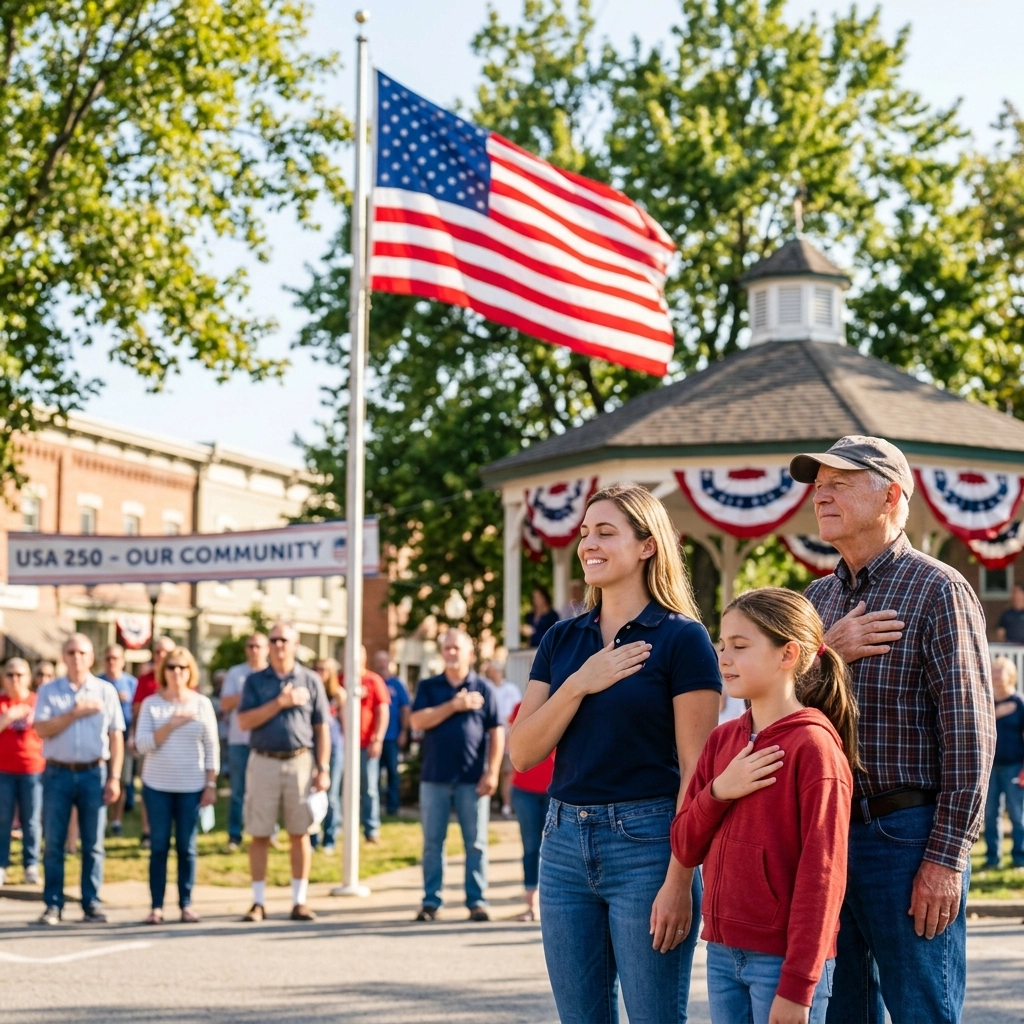
At Pledge Allegiance, we believe these rituals are the antidote to the "loneliness epidemic" and the political polarization we see on the news. When we stand together, face the flag, and recite those 31 words, we aren't Republicans or Democrats for those few seconds, we are Americans. We are a community.
America’s 250th: The Ultimate Turning Point
We are currently in the "Red, White, and Blue" zone. July 4, 2026, is approaching fast. This is the moment to decide what the next 250 years will look like. Will we be a nation that forgot its roots, or a nation that used its 250th birthday to spark a civic renaissance?
I’ve been writing about this daily in my letters to our community. If you want to know why thousands of patriots are waking up to these insights every morning, take a look at my daily CEO letter. We are building a movement of people who believe that unity is making a comeback.

The 250th anniversary is the perfect backdrop to reintroduce the Pledge to your family and your local schools. It’s not about "forced" patriotism; it’s about "informed" patriotism. It’s about knowing the story behind the words, like the 1954 change that added "Under God." If you’ve ever wondered about that specific piece of history, you can find 10 things you should know about the 1954 change on our site.
How You Can Lead the Charge
You don't have to wait for a government program to save our civic culture. Leadership starts in your living room, your classroom, and your local community center. Here is how you can take action today:
- Educate Yourself First: Dive into the history of our founding documents. Don't just read the "Cliff Notes", read the actual text. Understand the weight of the words.
- Model the Behavior: If you’re a parent or a teacher, let your kids see you treat civic traditions with respect. When the Pledge starts, stand tall. Explain why you’re doing it.
- Support Civic Education: Organizations across the country are fighting to put civics back in the center of the curriculum. You can support these efforts directly through donations that help us reach more schools and families.
- Join the Conversation: Stay informed with positive community news and updates on how we’re preparing for the 250th. Our daily press releases are a great place to start.
The Road to July 4th and Beyond
The decline in civic knowledge is a challenge, but it is not a death sentence. Strategies and programs are already in place to reverse this trend. The federal government has invested millions, and nonpartisan movements are popping up in every state to leverage the 250th as a time for service and unity.
But the real power lies with you.

Picture this: July 4, 2026. Every town square in America is filled with people who don't just know the words to the Pledge, but they know the heart of the message. They understand the mutual pledge of the Declaration. They see their neighbor not as an adversary, but as a partner in this great experiment.
Now, what if I told you that starting that shift is as simple as clicking a link or starting a conversation at dinner tonight?
Civic traditions aren't dead: they are sleeping. And it’s time for us to wake them up. Let’s make the 250th anniversary the year we stopped complaining about the state of the union and started building a more perfect one.
If you’re ready to be part of this mission, I invite you to learn more about us or head over to our shop to find tools that help you spread the message of civic pride in your own community.
Stay patriotic, stay engaged, and let's get to work. America is counting on us.
Dan Kost
CEO, Pledge Allegiance