
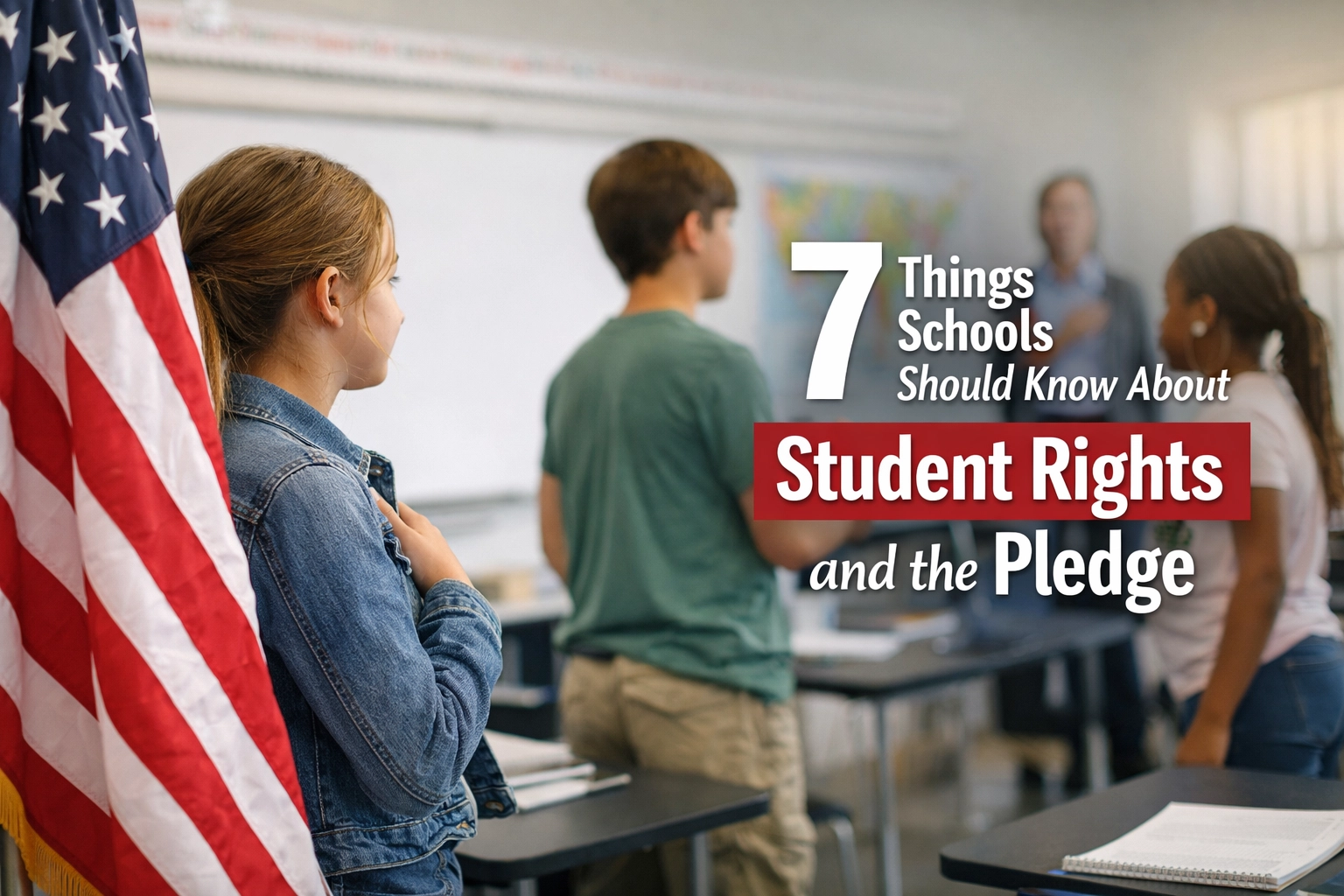
Most people think schools can mandate every student to stand and recite the Pledge of Allegiance… until they realize there’s an 80-year-old Supreme Court ruling that says otherwise.
As we approach the 250th anniversary of our great nation, the conversation around civic duty and individual liberty is more vibrant than ever. For school administrators and parents, navigating the intersection of patriotic tradition and constitutional law can feel like walking a tightrope. You want to foster a sense of national pride and unity, yet you must respect the very freedoms that make America worth celebrating in the first place.
At Pledge Allegiance, we believe that true patriotism is voluntary. It’s a choice made from a place of understanding and love for one’s country. To help you lead your classrooms and homes with confidence, we’ve broken down the seven essential things you need to know about student rights and the Pledge.
1. The Right to Opt Out is Constitutionally Protected
Let’s start with the big one: Public school students cannot be forced to stand for or recite the Pledge of Allegiance. This isn't just a suggestion or a "nice-to-have" policy: it’s a protected First Amendment right.
The First Amendment is famous for protecting your right to speak, but it also protects your right not to speak. In legal terms, this is called "compelled speech." The government (and yes, that includes public schools) cannot force a citizen to profess a belief they do not hold or to participate in a symbolic ceremony against their will.
Whether a student chooses to opt out for political reasons, religious beliefs, or personal convictions, their right to remain silent is absolute. For a deeper look at the legalities, check out our guide on what the law actually says regarding the Pledge.
2. History Matters: The 1943 Barnette Ruling
If you’re looking for the "why" behind these protections, you have to look back to 1943. While the world was embroiled in World War II, the U.S. Supreme Court made a landmark decision in West Virginia State Board of Education v. Barnette.
Justice Robert Jackson wrote one of the most famous sentences in American legal history in this 6-3 decision: "If there is any fixed star in our constitutional constellation, it is that no official, high or petty, can prescribe what shall be orthodox in politics, nationalism, religion, or other matters of opinion or force citizens to confess by word or act their faith therein."
This ruling overturned an earlier decision and established that patriotism cannot be coerced. It teaches us a powerful lesson: our strength as a nation lies in our freedom to choose our allegiances. When you respect a student's right to abstain, you are actually upholding the very constitutional values the Pledge represents.

3. State Laws Are Not All Created Equal
While the Supreme Court provides the federal floor, state laws add their own layers of complexity. You might be surprised to learn that 34 states have explicit exemptions or requirements to remind students they can't be forced to participate. However, the procedures for opting out vary wildly across state lines.
In states like Florida, Pennsylvania, Texas, and Utah, the law currently requires parental permission for a student to opt out of the Pledge. This adds a layer of administrative oversight for school leaders: you have to ensure you’re following state mandates while still respecting the federal constitutional protections that prevent student punishment.
On the other hand, five states have no pledge requirement at all. Knowing where your state stands is the first step in being a prepared and effective administrator. You can find more resources on navigating these civic requirements on our About page.
4. Private Schools Play by Different Rules
If you’re an administrator at a private institution, the rules of the game are different. Because the First Amendment restricts the government (state actors), private schools are generally not bound by these same constraints unless they receive specific types of federal funding that mandate otherwise.
A private school can make the Pledge of Allegiance a mandatory part of its curriculum or daily assembly. When parents enroll their children in a private school, they are essentially entering into a private contract and agreeing to follow that school's specific code of conduct and traditions. This distinction is vital for parents to understand when choosing the educational environment that best fits their family’s values.
5. Discipline is Off the Table
This is where many well-meaning educators run into trouble. You cannot punish a student for choosing not to participate in the Pledge.
Punishment can take many forms, and all of them are legally risky:
- Demerits or detention: Sending a student to the office for sitting during the Pledge is a violation of their rights.
- Grade reductions: You cannot lower a student's participation grade because they didn't recite the words.
- Physical coercion: Teachers cannot physically force a student to stand up or put their hand over their heart.
Even social shaming from a position of authority can be seen as a violation. Your role as an educator is to facilitate an environment where students feel safe expressing their civic identity, even if it looks different from yours.

6. Non-Participation Isn't Just "Sitting Quietly"
Students have multiple lawful ways to express their position during the Pledge, and as long as they aren't causing a "substantial disruption" to the learning environment, their actions are protected.
What does this look like in practice?
- Sitting silently: The most common form of opting out.
- Standing silently: Some students choose to stand out of respect for their peers but refrain from speaking the words.
- Raising a fist: In some contexts, federal courts have protected symbolic gestures of protest during the Pledge.
The keyword for administrators is disruption. A student who is shouting, mocking others, or physically interfering with the ceremony is not "opting out": they are disrupting. However, simply refusing to participate does not meet the legal threshold for disruption. It’s a fine line, but staying on the right side of it keeps your school out of legal hot water and keeps the focus on education.
7. Education is the Best Policy
The most common reason for conflict over the Pledge isn't malice: it's a lack of understanding. Many teachers and administrators simply haven't been briefed on the 80 years of settled law surrounding this issue.
Instead of waiting for a conflict to arise, be proactive. Use the Pledge as a "teachable moment" about the First Amendment. Explain the history of the Barnette case. Talk about why we value freedom of conscience in America. When students understand why they have the right to choose, they often develop a deeper respect for the traditions themselves.
At Pledge Allegiance, we’re committed to helping families and schools pass down patriotic traditions in a way that is meaningful and informed. Our Storykeeper program is a great way to engage students in the history of their own families and their country, building a bridge between the past and the future.

Building Unity in Your School
As we lead up to the nation’s 250th birthday, let’s focus on building unity rather than enforcing uniformity. When you respect student rights, you aren't "weakening" the Pledge: you are proving that the freedoms it describes are real and active in your hallways.
Encourage your students to explore the stories that made America what it is today. Pick up one of our Oral History Kits to help students connect with veterans and elders in their community. This kind of hands-on civic education does more to foster true patriotism than any forced recitation ever could.
Ready to bring more civic education to your community?
Explore our offerings or consider making a donation to support our mission of educating the next generation of American citizens. Let’s make the 250th anniversary a year of deep understanding and renewed commitment to the principles of liberty and justice for all.
Stay informed, stay patriotic, and keep leading with heart. If you have questions about implementing these practices in your school or home, don't hesitate to reach out to us. We’re all in this together.