
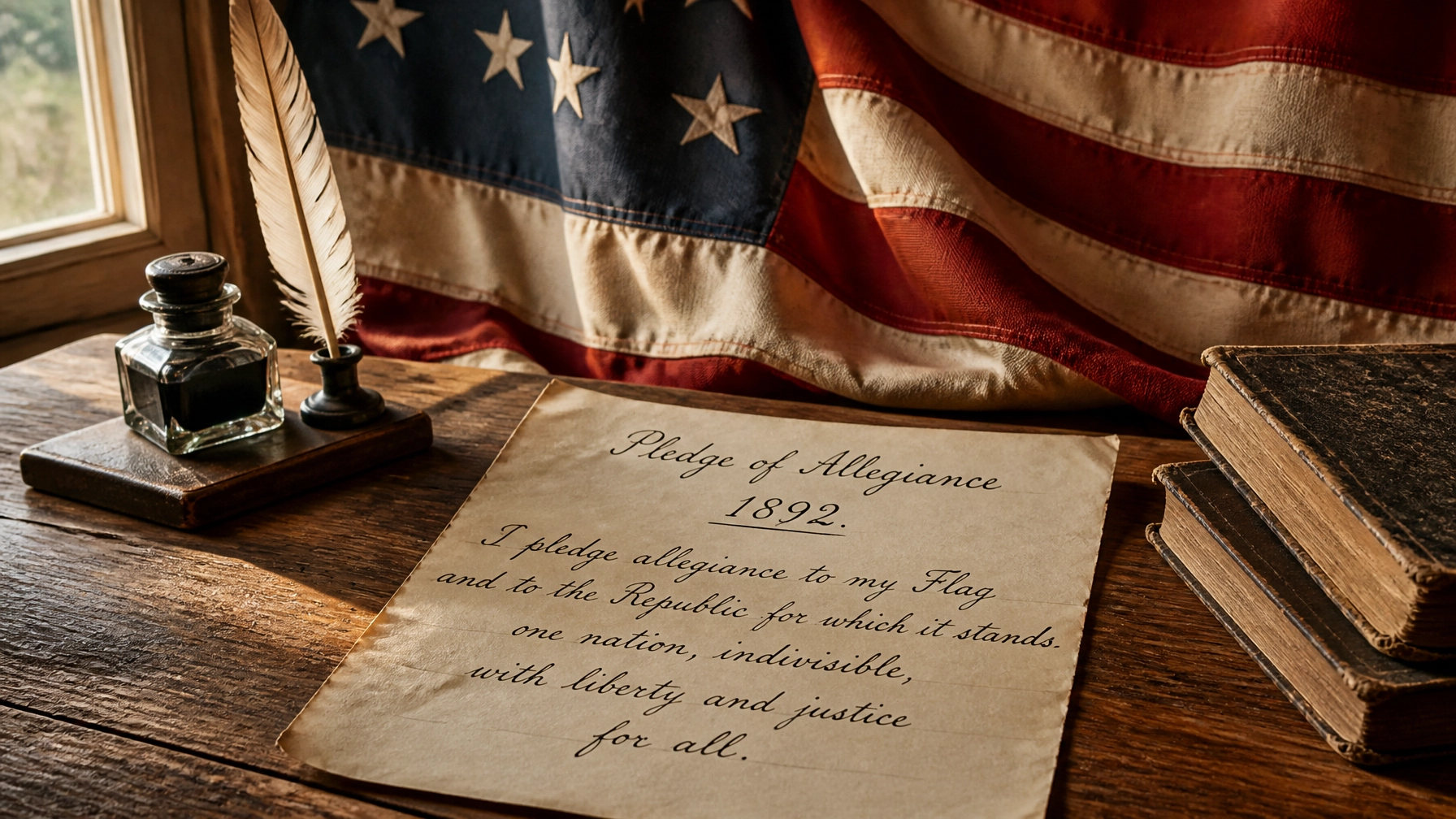
Most people think the Pledge of Allegiance has stayed exactly the same since it was first written in 1892: until they see the original manuscript and realize it didn't even mention the United States.
If you’re an educator, a homeschooling parent, or just a patriotic American, you know that the Pledge is more than just a morning routine. It’s a living document that has evolved alongside our nation. As we approach America’s 250th anniversary, there is no better time to dive deep into the real history.
Hook your students and family by moving beyond the memorized words. Use these ten primary sources to spark a conversation about what it actually means to "pledge allegiance" to a Republic that is constantly striving for "liberty and justice for all."
1. The Original 1892 Wording (The Youth’s Companion)
Start at the very beginning. Francis Bellamy’s original text was published in the September 8, 1892, issue of The Youth’s Companion.
Why it matters: The original version read: "I pledge allegiance to my Flag and to the Republic for which it stands; one Nation, indivisible, with Liberty and Justice for all." Notice what's missing? There’s no mention of the United States or God.
Teaching Tip: Ask your kids why they think Bellamy used the phrase "my Flag" instead of "the Flag of the United States." It’s a great way to discuss the post-Civil War era and the effort to unify a fractured country.
2. The 1923 National Flag Conference Proceedings
By the 1920s, the "Americanism" movement was in full swing. At the first National Flag Conference, the wording was changed from "my Flag" to "the flag of the United States."
Why it matters: This change was largely driven by concerns that immigrants might be pledging allegiance to their original home flags while reciting the Pledge in American schools.
Teaching Tip: Use this to discuss the concept of national identity and how the U.S. has integrated "the tired, the poor, and the huddled masses" into our civic fabric.
3. The 1942 U.S. Flag Code (4 U.S.C. § 4)
For the first fifty years of its life, the Pledge was just a custom: not a law. That changed during World War II when Congress officially recognized it as part of the U.S. Flag Code.
Why it matters: This was the first time the federal government stepped in to formalize the ritual. It reflects the high-stakes patriotism of the wartime era.
Teaching Tip: Compare this legal document to the original magazine article. Ask: Should the government dictate how we express our patriotism?

4. The 1954 "Under God" Amendment
The final major change to the Pledge occurred during the Cold War. President Dwight D. Eisenhower signed the law adding the words "under God" on Flag Day, 1954.
Why it matters: This was a direct response to the "godless Communism" of the Soviet Union. Eisenhower remarked that this addition would "reaffirm the transcendence of religious faith in America's heritage and future."
Teaching Tip: This source is perfect for high schoolers. It allows for a nuanced discussion on the First Amendment and how global politics (like the Cold War) can shape domestic traditions.
5. The Declaration of Independence (1776)
While not about the Pledge itself, this is the foundational "source text" for the phrase "liberty and justice for all."
Why it matters: You can’t understand the promise of the Pledge without understanding the "unalienable rights" mentioned by Jefferson. The Pledge is essentially a daily promise to uphold the ideals of 1776.
Teaching Tip: Side-by-side comparison. Have your students find themes from the Declaration that appear in the Pledge. It reinforces that our civic values are a continuous thread.
6. The Preamble to the U.S. Constitution
The Pledge mentions the "Republic for which it stands." If the Flag is the symbol, the Constitution is the blueprint.
Why it matters: The Preamble defines what that Republic is trying to do: "establish Justice, insure domestic Tranquility… and secure the Blessings of Liberty."
Teaching Tip: Connect the "indivisible" part of the Pledge to the Preamble’s goal of forming a "more perfect Union." It helps students see that unity is a goal we are still working toward.
7. West Virginia State Board of Education v. Barnette (1943)
This is arguably the most important Supreme Court case regarding the Pledge. Justice Robert Jackson’s opinion is a masterclass in American civic philosophy.
Why it matters: The Court ruled that schools cannot force students to say the Pledge. Justice Jackson famously wrote that no official can "prescribe what shall be orthodox in politics, nationalism, religion, or other matters of opinion."
Teaching Tip: This is a vital lesson in the "Justice" part of the Pledge. It teaches that in a free Republic, patriotism must be voluntary to be meaningful.

8. The Gettysburg Address (1863)
Abraham Lincoln’s speech is the spiritual predecessor to the "indivisible" clause of the Pledge.
Why it matters: Lincoln’s vision of a "new birth of freedom" and a government "of the people, by the people, for the people" is exactly what we are pledging to support.
Teaching Tip: Discuss the word "indivisible." In 1892, when the Pledge was written, the memory of the Civil War was still very much alive. How does Lincoln’s speech help explain why "indivisible" was such an important word to include?
9. The 14th Amendment (Section 1)
If the Pledge promises "justice for all," the 14th Amendment is the legal engine that makes it possible.
Why it matters: The Equal Protection Clause ensures that "justice" isn't just for a select few. It’s the constitutional backbone of the Civil Rights movement and our modern understanding of American citizenship.
Teaching Tip: Challenge your students to define what "all" means. How has our definition of "all" changed from 1776 to 1892 to today?
10. The 1892 Columbus Day School Program Circular
This is a "behind the scenes" look at the very first National Public School Celebration.
Why it matters: It shows that the Pledge was originally designed for children to lead. It wasn't a top-down government mandate; it was a grassroots educational movement aimed at teaching the next generation about their responsibilities as citizens.
Teaching Tip: Look at the original instructions for the "Bellamy Salute" (which was later changed because it looked too much like the Nazi salute). It’s a powerful lesson in how symbols and gestures change meaning over time.

Why This Matters for America’s 250th
As we approach the Semiquincentennial in 2026, we have a unique opportunity to revitalize civic education. We don't just want our kids to recite words; we want them to understand the weight behind them.
At Pledge Allegiance, we believe that replacing assumptions with actual knowledge is the key to a healthier democracy. Whether you are using our Civic Education Classroom Programs or exploring our Veterans Initiatives, the goal is the same: to foster a deep, informed love for the Republic.
Take Action Today:
- Explore our blog for more deep dives into why the Pledge still matters.
- Download resources that help explain how teaching Pledge history prepares our kids for the future.
- Join the conversation and help us preserve the stories of those who have lived out their pledge of allegiance.
The Pledge is a promise. By exploring these primary sources, you aren't just teaching history: you're teaching your students how to keep that promise for the next 250 years.