
Most people think we have always placed our hands over our hearts to honor the flag, until they see a photograph of an American classroom from 1910.
Picture this: rows of school children standing tall, their eyes fixed on Old Glory, but instead of the familiar hand-over-heart, their right arms are stiffly extended toward the flag, palms down. To a modern eye, it is a jarring, even unsettling sight. You might mistake it for a scene from a different country and a darker era.
Yet, for five decades, this was the standard way to pledge allegiance to the United States. It was known as the Bellamy salute, and its disappearance is one of the most profound examples of how American patriotism is not a static relic, but a living, breathing commitment that has the humility to change when our values are at stake.
As we approach America's 250th anniversary, understanding the history of the Pledge of Allegiance is about more than just trivia. It’s about recognizing the thoughtful way our ancestors protected the integrity of our national symbols.
The Birth of the Bellamy Salute (1892)
The story begins in 1892, a year that marked the 400th anniversary of Christopher Columbus’s arrival in the Americas. To celebrate, a socialist minister named Francis Bellamy wrote a brief, punchy oath for a national school program. His goal was to foster a sense of national unity in a country still healing from the wounds of the Civil War.
But a pledge needs a gesture, a physical anchor to the words. Bellamy’s original instructions were specific:
"At a signal from the Pupil-Leader, every pupil gives the flag the military salute, right hand lifted, palm downward, to a line with the forehead and close to it. Standing thus, all repeat together, slowly, ‘I pledge allegiance to my Flag…’ At the words, ‘to my Flag,’ the right hand is extended gracefully, palm upward, toward the Flag, and remains in this gesture till the end of the affirmation."
Over time, this evolved into the "Bellamy salute." By the early 20th century, the "palm upward" part was often forgotten, and millions of Americans grew up extending their right arm straight out, palm down, in a gesture meant to signify dignity and civic devotion. For decades, this was simply how you showed you were a loyal citizen.

When a Gesture Becomes a Threat
Imagine you are an American parent in the late 1930s. You sit down to watch the newsreels at your local theater, and you see terrifying footage from Europe. You see thousands of people in Berlin and Rome raising their arms in a stiff, palm-down salute to dictators like Adolf Hitler and Benito Mussolini.
Then, the next morning, you drop your child off at school and watch them perform a gesture that looks almost identical.
By the time World War II erupted, the Bellamy salute had become a source of deep national anxiety. What was once a symbol of American unity now bore a haunting resemblance to the "Heil Hitler" salute of the Nazi regime. The visual connection was so strong that it began to overshadow the words of the Pledge themselves.
If you’ve ever felt like a tradition was losing its meaning because of external events, you can understand the dilemma Americans faced. How do you honor your country using a gesture that has become synonymous with everything your country is fighting against?
The 1942 Transition: A Nation in Conflict
As the United States officially entered the war following the attack on Pearl Harbor, the pressure to change the salute reached a boiling point. Veterans groups, schools, and civic leaders began to call for a new way to honor the flag, one that was unmistakably American.
Congress finally stepped in on June 22, 1942. In the first formal codification of the U.S. Flag Code, they attempted a compromise. They kept the arm extension but instructed that it be done "palm upward" toward the flag, hoping this slight variation would distinguish it from the fascist salutes of Europe.
But it wasn't enough. The visual confusion persisted, and the American public remained uncomfortable. The "palm upward" gesture still felt too close to the very movements our soldiers were dying to defeat overseas.

December 22, 1942: The Heart Takes Center Stage
In a rare move of rapid legislative correction, Congress revisited the Flag Code just six months later. On December 22, 1942, they passed an amendment that changed the American civic landscape forever.
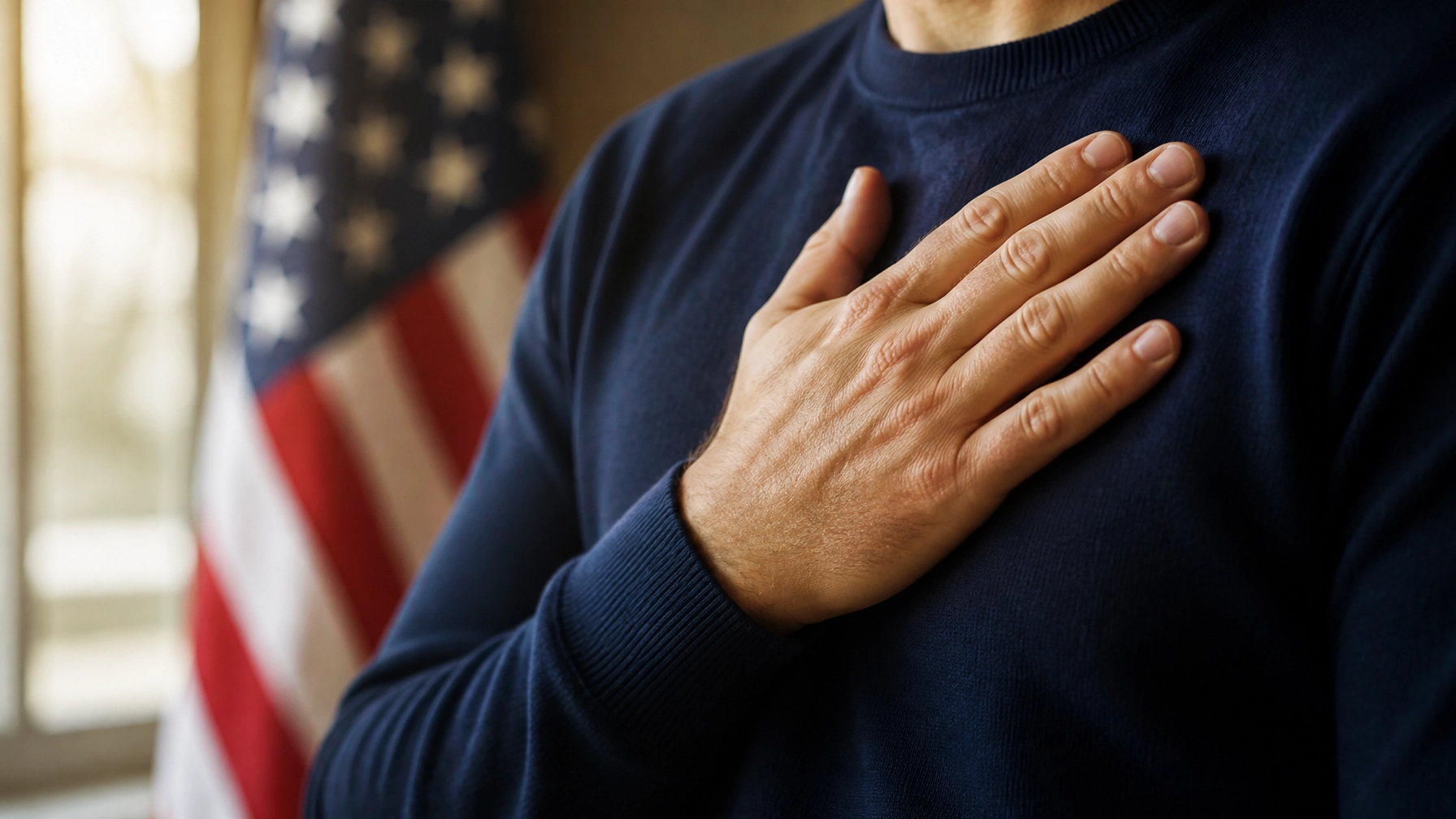
The new law was simple and definitive: the Pledge of Allegiance was to be rendered by standing with the right hand over the heart.
This change ended the Bellamy salute for good. Almost overnight, schools across the nation transitioned to the hand-over-heart gesture. Veterans groups embraced it. It was a moment of national alignment, a declaration that our loyalty wasn't just a formal, "Roman-style" salute, but a personal, heartfelt commitment.
Why This Change Matters for Civic Education Today
You might wonder: does it really matter how we move our hands while we speak?
In the world of civic education, the answer is a resounding yes. This historical shift teaches us two vital lessons about American patriotism:
- Patriotism is Thoughtful: We didn't change the salute because of a whim. We changed it because we realized that our symbols must reflect our values. When a gesture started to represent tyranny, we had the wisdom to abandon it in favor of something that represented liberty.
- We Are Capable of Change: Traditions are not chains; they are anchors. Sometimes, you have to move the anchor to keep the ship from drifting. The transition from the Bellamy salute to the hand-over-heart shows that we can adapt our rituals to better serve our ideals.
This flexibility is a hallmark of the American spirit. We don't hold onto things just because "that's how they've always been done." We hold onto things because they are true, and when the form no longer matches the truth, we fix it.

A Legacy of the Greatest Generation
The hand-over-heart tradition is, in many ways, a gift from the Greatest Generation. It was their discomfort with fascism and their love for freedom that cemented this gesture into our daily lives. Every time you place your hand over your heart today, you are participating in a tradition that was forged in the fire of World War II.
It is a gesture that says, "My loyalty is internal. It is personal. It is heartfelt." It moves the Pledge from a public display of obedience to a private vow of character.
A Reflection for You
Next time you stand for the Pledge, take a moment to feel the weight of your hand against your chest. Think about the millions of school children in 1942 who had to learn a new way to honor their country.
Does knowing that the hand-over-heart was a deliberate choice to stand against tyranny change how you feel when you recite the Pledge today?
How You Can Keep the Story Alive
At Pledge Allegiance, we believe that reclaiming your patriotic spirit starts with knowing our shared story. Replacing assumptions with actual knowledge is the first step toward informed civic participation.
Here is how you can take action today:
- Share this story: The next time you see a veteran or a young student, tell them about the Bellamy salute. Explain why we use our hearts instead of our arms.
- Be Mindful: Don't let the Pledge become a "mindless ritual." Remember the sacrifice of the generation that gave us this gesture.
- Educate: If you are a teacher or a parent, use this history to spark a conversation about why American values are worth protecting.
The hand over the heart isn't just a rule in a book, it’s a symbol of a nation that chose heart over hollow gestures. Let’s keep that heart beating strong.

Frequently Asked Questions (FAQ)
What was the Bellamy salute?
The Bellamy salute was the original gesture used for the Pledge of Allegiance, involving an outstretched right arm with the palm facing down or slightly up toward the flag. It was named after Francis Bellamy, the author of the Pledge.
Why was the Bellamy salute changed?
It was changed during World War II because it closely resembled the fascist salutes used by the Nazi regime in Germany and the Italian fascists under Mussolini. To avoid any association with these ideologies, the U.S. adopted the hand-over-heart gesture.
When did the hand-over-heart become official?
While many began using it earlier out of discomfort, Congress officially mandated the hand-over-heart gesture for the Pledge of Allegiance on December 22, 1942, by amending the U.S. Flag Code.
Who wrote the Pledge of Allegiance?
The Pledge was written by Francis Bellamy in August 1892. It has since been amended several times, including the addition of "under God" in 1954.
Is the hand-over-heart used for the National Anthem too?
Yes. The U.S. Flag Code specifies that during the rendition of the national anthem, civilians should stand at attention with their right hand over their heart.