
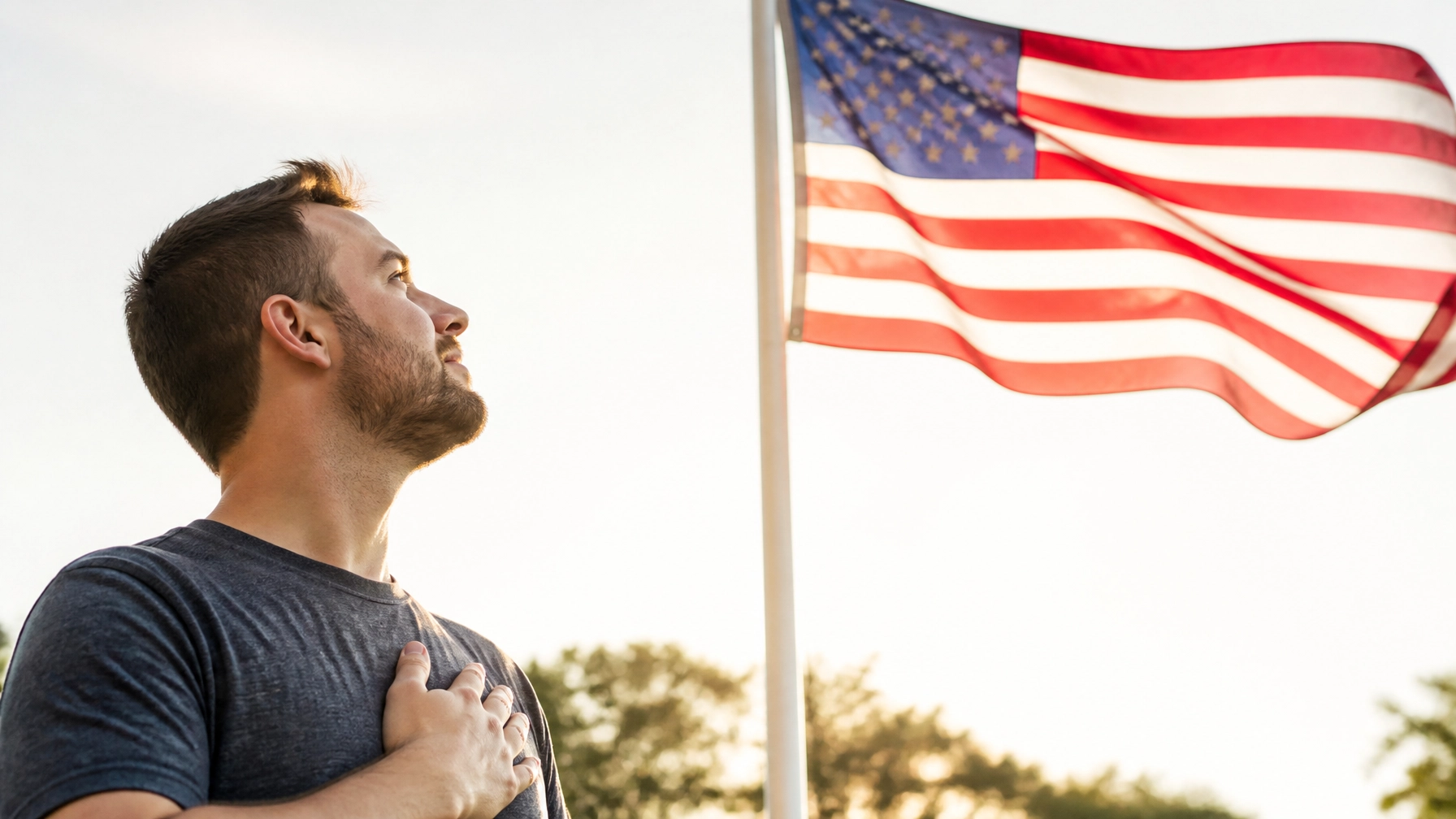
Take a moment to picture the iconic daily ritual: standing tall, turning toward the star-spangled banner, and placing your right hand firmly over your heart as you recite the Pledge of Allegiance. To millions of Americans, this gesture is second nature, a quiet moment of reflection, unity, and shared heritage.
But have you ever wondered if this exact physical posture was always the standard?
Most people assume the hand-over-heart tradition has existed since the very inception of the American republic. The reality is far more fascinating. For the first fifty years of its existence, the Pledge of Allegiance was accompanied by a completely different physical gesture, one that bore a striking resemblance to a European salute we now associate with totalitarian regimes.
Uncovering the history of the Pledge of Allegiance is not just an exercise in trivia; it is a masterclass in how American democracy constantly adapts, course-corrects, and fiercely guards liberty of conscience. As we approach the upcoming America 250th anniversary, examining the evolution of our flag etiquette gives us a profound window into what true patriotism really means. Let’s dive deep into the story behind the salute that changed.
1. The Birth of the Pledge and the Bellamy Salute (1892)
To understand our flag etiquette today, you have to rewind to 1892. In celebration of the 400th anniversary of Christopher Columbus’s arrival in the Americas, a magazine editor named James B. Upham and a Baptist minister named Francis Bellamy collaborated to create a unifying civic program for America’s public schools.
Bellamy authored a concise, powerful 23-word pledge designed to instill national unity among a rapidly growing and diversifying immigrant nation. Accompanying this new pledge was a specific physical action known as the Bellamy salute:
- Stand at attention.
- Extend your right arm straight out toward the flag, with your palm facing downward (or upward in later iterations).
- Hold that position while reciting the words.

For generations of schoolchildren growing up in the late 19th and early 20th centuries, raising the right arm toward the flag was an everyday occurrence. It was taught in classrooms from coast to coast as a symbol of loyalty and devotion to the republic. But history never stands still, and global events soon forced a dramatic rethinking of this physical gesture.
2. The Shadow of History: Why the Salute Had to Change
Fast forward to the late 1930s. Across the Atlantic Ocean, fascist and Nazi regimes in Italy and Germany rose to power, adopting rigid, straight-arm salutes to project absolute state control and ideological conformity.
Imagine walking into an American schoolroom in 1940 and watching children extend their right arms in a straight line toward the Stars and Stripes. As newsreels from Europe flooded American theaters, the visual overlap became impossible to ignore. A gesture originally conceived to celebrate American liberty began to mirror the menacing choreography of totalitarian oppression.
- Address the discomfort: Citizens and veterans alike recognized the jarring contradiction.
- Recognize the danger: Symbols matter, and visual alignment with fascism was completely antithetical to American values.
- Demand change: The American Legion, the Veterans of Foreign Wars (VFW), and everyday citizens began urging leaders to update our national practices.
When a nation founded on freedom sees its traditions visually hijacked by tyrants abroad, swift adaptation is essential. Congress realized that America’s civic traditions needed to stand visibly apart from tyranny.
3. The 1942 Flag Code and the Hand-Over-Heart Tradition
In response to rising public concern during World War II, the United States Congress took decisive action. On June 22, 1942, Congress codified the first comprehensive National Flag Code (Public Law 77-623). Months later, on December 22, 1942, Congress passed Public Law 77-829, officially amending the code to replace the extended-arm gesture entirely.
The new rule was simple, elegant, and enduring: the Pledge of Allegiance should be rendered by standing with the right hand over the heart.

This wasn't merely a cosmetic adjustment. By moving the hand from an outward extension to the center of the chest, America made a powerful statement. Loyalty to the nation was no longer about pointing outward in forced uniformity; it was about connecting inward, anchored in the heart, personal conscience, and individual devotion. To explore more about how our historical traditions continue to shape our communities, visit our Pledge Allegiance offerings and educational programs.
4. The Supreme Court Steps In: West Virginia v. Barnette (1943)
Changing the physical salute solved the immediate visual dilemma, but a profound constitutional question remained: Could the government legally force anyone to recite the Pledge or perform the salute at all?
Just six months after the Flag Code amendment, the United States Supreme Court answered that question with a resounding "No."
In the landmark 1943 case West Virginia State Board of Education v. Barnette, the Court ruled that public school students could not be compelled to salute the flag or recite the Pledge against their religious or personal convictions. Writing for the majority, Justice Robert H. Jackson penned some of the most inspiring words in American jurisprudence. He famously declared that our fundamental rights do not depend on the vote of any majority:
"If there is any fixed star in our constitutional constellation, it is that no official, high or petty, can prescribe what shall be orthodox in politics, nationalism, religion, or other matters of opinion or force citizens to confess by word or act their faith therein."
Think about the weight of that statement. True freedom means that patriotism cannot be manufactured through coercion. When you stand and place your hand over your heart today, you do so not because a government official holds a gavel over your head, but because you choose to honor the ideals of a free republic.
5. Connecting Past to Present: America at 250 and Beyond
As the United States approaches its historic 250th anniversary, exploring our civic roots is more important than ever. History shows us that American traditions are dynamic. They evolve when citizens have the courage to question, reflect, and refine our practices in pursuit of a more perfect union.

Today, comprehensive civic education means looking beyond rote memorization. It means understanding:
- Why our symbols were shaped by historical trials.
- How the First Amendment protects dissent and voluntary participation.
- Why civil dialogue and community engagement strengthen our democratic fabric.
Whether you are an educator designing a classroom program, a parent discussing history around the dinner table, or a veteran sharing your story, you play an active role in preserving American civic life. Discover more insights on our blog page and learn how you can get involved.
Conclusion: Honor Your Freedom Today
The evolution from an extended arm to a hand over heart is a reminder that American democracy is resilient, self-correcting, and deeply rooted in individual liberty. We don't demand robotic compliance; we invite conscious devotion.
Take this insight forward with you. The next time you stand for the Pledge, feel the weight of the history behind it: a history where freedom of conscience won out over compulsion, and where our national salute became a genuine gesture of the heart.
Ready to deepen your connection to America’s civic heritage? Explore our programs and resources today and help keep the spirit of informed, voluntary patriotism alive in your community.