
Most people think the Pledge of Allegiance has always sounded the same: a timeless sequence of words etched into the American soul from the very beginning. But what if I told you that for over thirty years, the Pledge you recite every morning was fundamentally different?
Until 1923, millions of Americans didn’t pledge to "the Flag of the United States of America." They pledged to "my Flag." It sounds like a small distinction, but that two-word shift represents one of the most significant moments in the history of the Pledge of Allegiance. It was a move from personal ownership to national unity: a transition that defined how we view our civic responsibilities as we march toward the America 250th anniversary.
The "My Flag" Era: A Universal Promise
When Francis Bellamy penned the original Pledge in 1892, he wasn't just writing for Americans. He was writing a tribute to the concept of a republic. His original wording was lean and rhythmic:
"I pledge allegiance to my Flag and the Republic for which it stands, one nation, indivisible, with liberty and justice for all."
Bellamy intentionally used the phrase "my Flag" because he believed the sentiment was universal. He envisioned a world where any person, in any nation, could face their own banner and recite these words of loyalty to their respective republic. While his heart was in the right place regarding the global spread of liberty, the practical reality in a rapidly growing America was becoming complicated.
Why 1923 Changed Everything
Picture the United States in the early 1920s. The nation was emerging from the shadows of World War I, and waves of immigrants were arriving at Ellis Island, seeking the American Dream. In classrooms across the country, children from dozens of different backgrounds stood side-by-side.
But there was a concern among civic leaders: when a child born in another country said "my Flag," which flag were they thinking of? Were they pledging to the Stars and Stripes, or were they silently honoring the colors of their homeland?
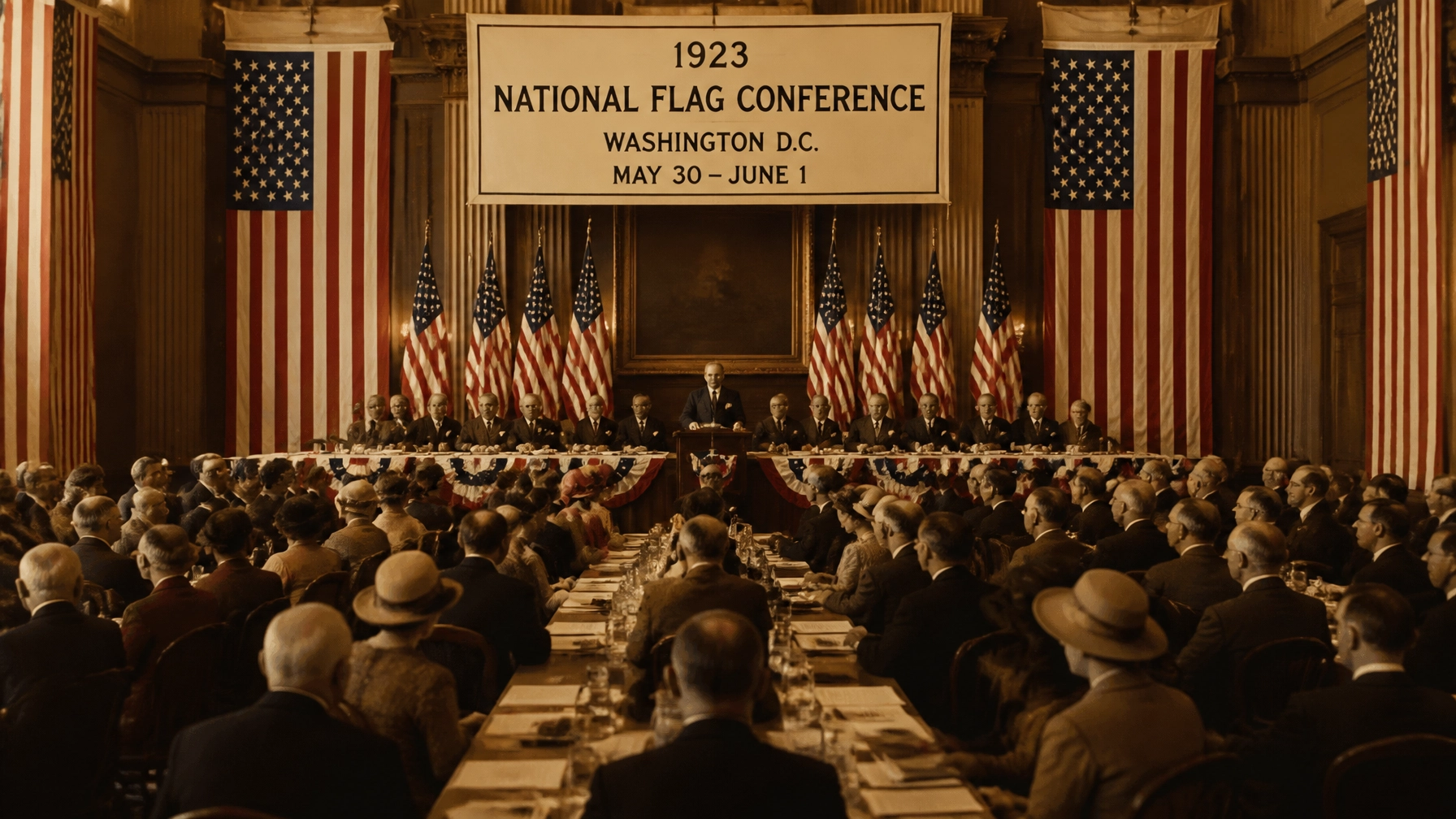
This wasn't about exclusion: it was about clarity. To build a unified nation, leaders realized that we needed a shared vocabulary of loyalty. This realization led to the 1923 National Flag Conference.

Inside the Room: The American Legion Takes the Lead
On Flag Day, June 14, 1923, more than 60 patriotic organizations gathered in Washington, D.C. The conference was spearheaded by the American Legion and the Daughters of the American Revolution. Their mission was simple but massive: establish a formal Flag Code to ensure the American flag was treated with the respect it deserved.
Dive deep into the minutes of that meeting, and you’ll find a group of veterans and civic leaders who were deeply worried about national cohesion. They argued that "my Flag" was too ambiguous. To fix this, they officially amended the wording to:
"I pledge allegiance to the flag of the United States…"
This change was a radical departure from Bellamy's "rhythmic balance," which he famously complained about later. But the delegates knew something Bellamy didn't: that a nation is only as strong as its shared commitments. By naming the flag specifically, they were anchoring the speaker’s loyalty to this specific soil, this specific Constitution, and this specific people.
The 1924 Refinement: Adding "of America"
The work wasn't quite finished. Just one year later, in 1924, a second conference was held to add even more precision. Delegates realized there were other "United States" in the world (such as the United States of Brazil or the United States of Mexico). To leave absolutely no room for doubt, they added the final two words of that phrase: "of America."
Now, the Pledge had its modern geographical anchor. You weren't just pledging to a vague idea; you were pledging to the United States of America. You can explore more about how these historical shifts impact our current celebrations in our deep dive on why discovering the Pledge's original meaning will change the way you celebrate America's 250th.
Civic Leadership and the Power of Words
Why does this history matter to you today? Because it reminds us that American values are not static: they are actively maintained through civic leadership. The men and women at the 1923 conference didn't just complain about a lack of unity; they organized, debated, and took action to create a standard that has lasted over a century.
This is the heart of civic education. When you understand that the Pledge was "edited" to ensure that every immigrant and every native-born citizen stood on the same ground, the ritual becomes much more than a classroom routine. It becomes a testament to our ongoing effort to be "one nation, indivisible."

Preparing for America's 250th Anniversary
As we approach the America 250th anniversary in 2026, we have a unique opportunity to revitalize these traditions. We shouldn't just recite the words; we should investigate them.
- Ask yourself: What does "the Republic for which it stands" actually mean in your daily life?
- Coach your children: Don't let them just memorize the sounds. Help them understand the 1923 shift from "me" to "us."
- Engage your community: Use the Pledge as a starting point for discussions about our shared responsibilities.
We’ve put together a list of the top 10 patriotic classroom ideas for teaching the Pledge that can help you spark these conversations in your local schools.
A Call to Action: Be the Bridge
History is a relay race. The delegates of 1923 passed the baton to the generation that fought World War II, who passed it to the generation that saw the addition of "under God" in 1954, and now, the baton is in your hands.
Civic education is the key to ensuring that the next 250 years are as resilient as the last. We are currently seeing a massive resurgence in this field, and for good reason. You can read more about why everyone is talking about civic education again and how it serves as the foundation for our national future.

Your next step is simple: The next time you stand for the Pledge, think about the year 1923. Think about the delegates who sat in that humid D.C. hall to make sure that when you say "the Flag of the United States of America," you are speaking for all of us, not just yourself.
Let's honor their legacy by being informed, active, and united participants in this great experiment we call America.