
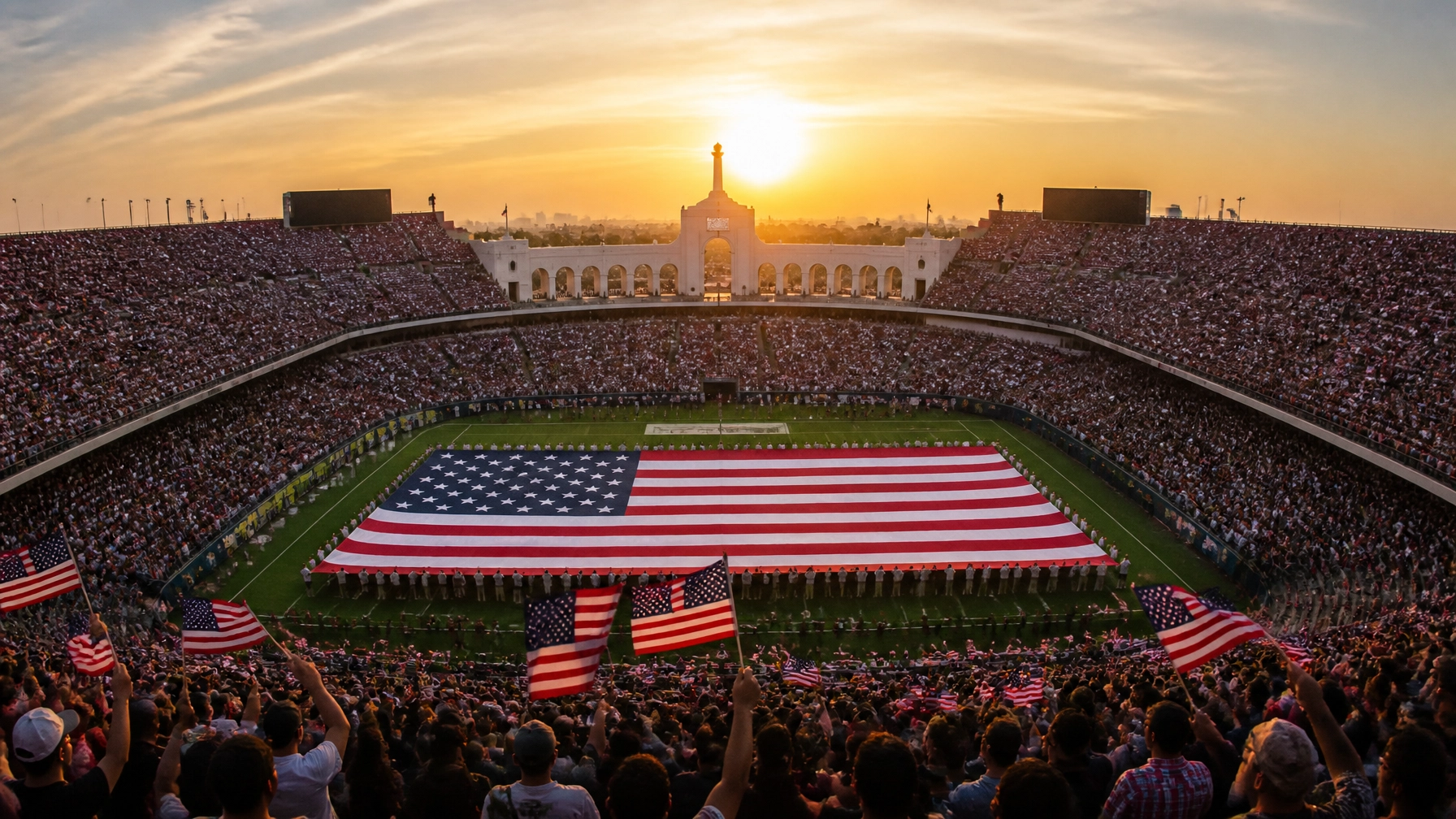
Picture this: The year is 1926. The summer sun is setting over the Los Angeles Memorial Coliseum. You’re sitting among thousands of fellow Americans, the air thick with anticipation. On the field below, the "Pageant of Liberty" is in full swing: a massive, theatrical celebration of America’s 150th anniversary, the Sesquicentennial. Suddenly, the crowd rises as one. Thousands of voices join together in a rhythmic, powerful cadence: "I pledge allegiance to the Flag of the United States of America…"
At that moment, the words weren't just a routine; they were a relatively new national standard, a unifying promise during a time of immense growth and change. Now, as we approach America’s 250th anniversary (the Semiquincentennial) in 2026, those same words remain our collective heartbeat.
Understanding the history of the Pledge of Allegiance isn’t just about memorizing facts: it’s about discovering the thread that ties your grandfather’s generation to your children’s future.
The Turning Point: The 1923 and 1924 National Flag Conferences
Most people think the Pledge has always been exactly as we say it today. But if you were a student in 1922, your morning ritual would have sounded slightly different. You would have said, "I pledge allegiance to my flag."
Why did that change?
In the early 1920s, the American Legion and other patriotic organizations grew concerned about clarity. They worried that for the millions of new immigrants arriving in the United States, "my flag" might still refer to the flags of their birth nations. To ensure there was no confusion about the object of our shared loyalty, the 1923 National Flag Conference in Washington, D.C., replaced "my flag" with "the flag of the United States."
A year later, at the 1924 National Flag Conference, they added two more crucial words: "of America." This established the foundational wording that would eventually be recited at the 150th-anniversary celebrations just two years later. These conferences transformed the Pledge from a local schoolhouse tradition into a nationally standardized civic oath.

The 1926 Sesquicentennial: A Moment of National Unity
By July 1926, the newly standardized Pledge was ready for its biggest stage yet. During the Sesquicentennial celebrations, the Pageant of Liberty at the LA Coliseum featured a version of the Pledge that looks remarkably familiar to us today:
"I pledge allegiance to the Flag of the United States of America, and to the Republic for which it stands, one Nation, indivisible…"
Notice something missing? The phrase "under God" wasn't added by Congress until 1954. Yet, even without those two words, the core Pledge of Allegiance meaning was clear to the thousands gathered in that stadium: unity, indivisibility, and a shared commitment to the Republic.
For the families and veterans in attendance in 1926, the Pledge served as a bridge. It connected the rugged history of the first 150 years to the modern, industrial powerhouse America was becoming. It was a moment of reflection on how far the nation had come: and a promise of where it was going.
Why Civic Education Matters for the Next Century
As we look toward the America 250th anniversary, you might wonder why we should still focus so heavily on a century-old history. The answer is simple: civic education is the foundation of a healthy democracy.
When you teach a child the history behind each phrase, you replace a rote habit with a deep-seated understanding. You’re not just teaching them words; you’re teaching them about the 15 little-known Pledge facts that make our history vibrant. You’re helping them avoid the common mistakes people make when explaining these traditions to the next generation.

At Pledge Allegiance, we believe that understanding our past is the only way to navigate our future. Our mission is to replace assumptions with knowledge, creating a space where everyday Americans can become informed participants in our democracy.
Bridging the Gap: From 1926 to 2026
Think about the timeline. A child who recited the Pledge at the LA Coliseum in 1926 would have grown up to see the moon landing and perhaps even the start of the digital age. Now, the children in your classrooms or around your dinner table are the ones who will lead us through the next 50 years.
The history of the Pledge of Allegiance acts as a generational handshake. It allows a veteran who served decades ago to stand shoulder-to-shoulder with a first-grader, both speaking the same words of commitment. This shared language is exactly what we need as we prepare for the Semiquincentennial in 2026.
How You Can Participate in America's 250th
The 250th anniversary isn't just about fireworks and parades; it's about building civic unity. You have a unique opportunity to lead this conversation in your home, school, or community organization.
- For Educators: Use the story of the 1923/24 Flag Conferences to show your students that our traditions are living, breathing parts of history.
- For Families: Share the story of the 1926 Sesquicentennial. Ask your children what "one nation, indivisible" means to them in their world today.
- For Veterans: Your stories are the bridge. When you share your experiences of service alongside the history of the flag, you bring the Pledge to life in a way no textbook can.

Join the Conversation
We are on a journey toward July 4, 2026, and we want you to be a part of it. The Pledge is more than just a set of words: it is a promise we make to each other. By learning the "why" behind the "what," you are helping to preserve the stories of those who came before us and inspiring those who will follow.
Reflect on this: If you were standing in that stadium in 1926, what would you want the Americans of 2026 to know about the value of unity?
Take the first step in your civic journey today. Explore our resources, share this history with a friend, and let's prepare to celebrate 250 years of the American experiment with knowledge, respect, and pride.