
What if everything you’ve been told about the Pledge of Allegiance is wrong? Most people think these thirty-one words have remained unchanged since the founding of our country, but the truth is far more dynamic: and far more interesting. As we approach America’s 250th anniversary in 2026, understanding our civic traditions isn’t just a history lesson; it’s a way to reconnect with the heart of the American experiment.
Whether you are a veteran looking to preserve the stories of your service, an educator shaping the next generation of citizens, or a parent wanting to give your children a deeper sense of belonging, you’ve come to the right place. This guide will walk you through the fascinating evolution of the Pledge, breaking down its history from a simple school magazine promotion to a cornerstone of American life.
Uncover the Origins of a National Promise
Picture this: It’s 1892. The United States is grappling with rapid industrialization and a massive wave of immigration. The wounds of the Civil War are still healing, and the nation is searching for a way to unify its youngest citizens. Enter Francis Bellamy: a former minister and editor at The Youth’s Companion.
Bellamy was tasked with creating a patriotic program for public schools to celebrate the 400th anniversary of Christopher Columbus’s arrival. He wanted a "vow of allegiance" that was short, punchy, and meaningful. He didn't want a long-winded oath; he wanted something a child could memorize and feel in their bones. On October 21, 1892, an estimated 12 million schoolchildren recited Bellamy’s words for the first time.
But here is the kicker: the original version didn't mention the United States by name. It read: "I pledge allegiance to my Flag and to the Republic for which it stands, one Nation indivisible, with liberty and justice for all."

Watch the Evolution of the Script
You might be surprised to learn that the Pledge has been edited several times: acting as a living reflection of our shifting national identity. If you’ve ever wondered why we say "of the United States of America" instead of just "my flag," you can thank the National Flag Conferences of 1923 and 1924.
During this era, many leaders were concerned that immigrant children might be confused about which flag they were pledging to: their country of birth or their new home in America. To provide absolute clarity, the words were changed to "the Flag of the United States of America." It was a move designed to cement a singular national identity during a time of great global change.
The most famous addition, however, didn't happen until 1954. In the heat of the Cold War, President Dwight D. Eisenhower and Congress added the phrase "under God." This change was explicitly intended to contrast American values with the officially atheist ideologies of Communist regimes. As Eisenhower noted at the time, "From this day forward, the millions of our school children will daily proclaim in every city and town… the dedication of our nation and our people to the Almighty."
Understand the Shift in the Salute
Take a look at any old photo of the Pledge being recited before 1942, and you might see something startling. Originally, students used the "Bellamy salute": extending their right hand toward the flag with the palm up or down.
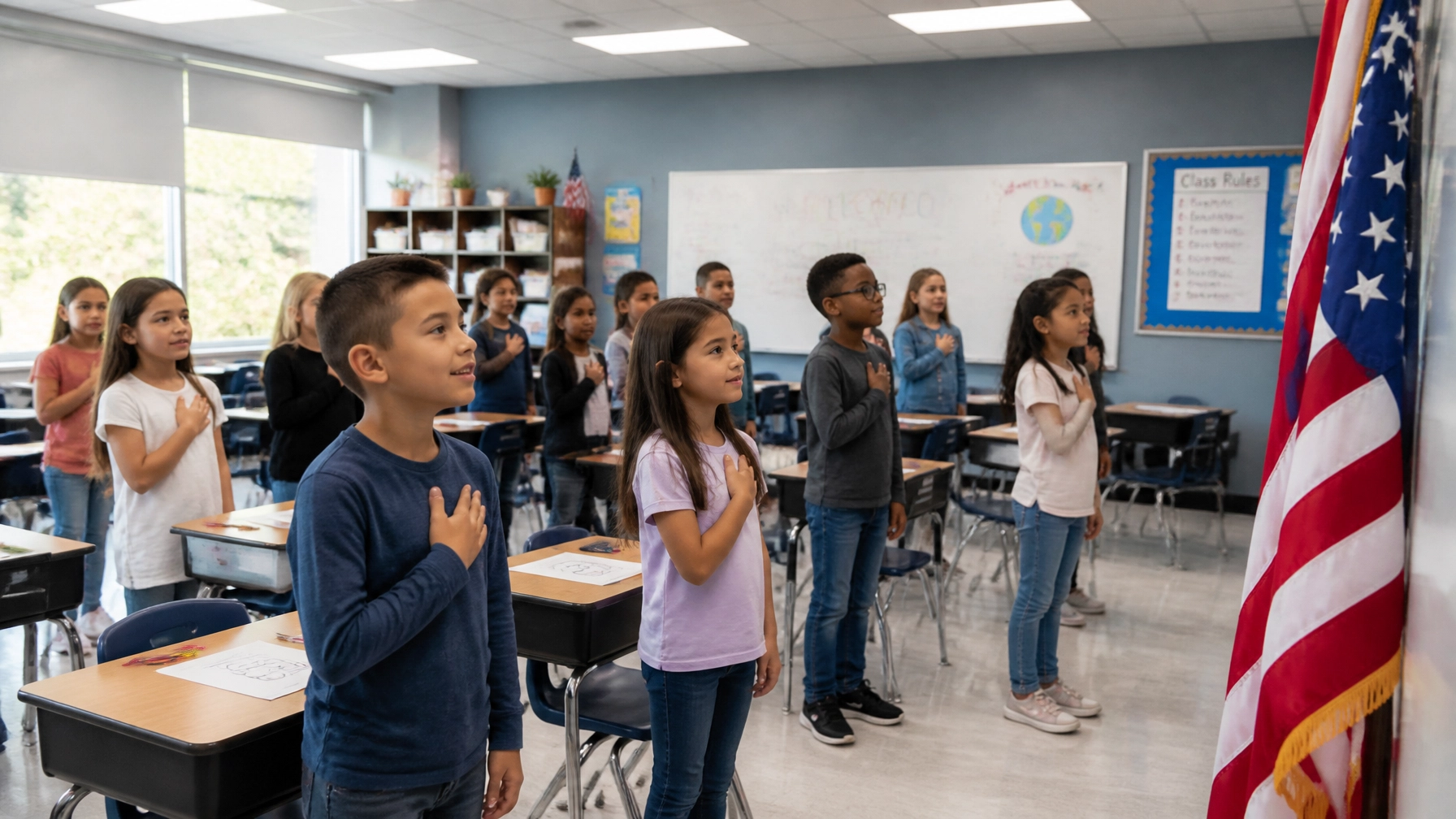
As the 1930s unfolded, this gesture became hauntingly similar to the salutes adopted by Nazi Germany and Fascist Italy. To avoid any confusion with these oppressive regimes, Congress officially amended the Flag Code in 1942, mandating the "hand over heart" gesture we all recognize today. This shift serves as a powerful reminder that our civic traditions are not just about the words we say, but about the values we project to the world.

Dive Deep into the Power of the Phrases
To truly master our civic traditions, you must look past the ritual and into the meaning of the words. When you recite the Pledge, you aren't just reciting a script; you are engaging in a coaching session for your own citizenship.
- "I pledge allegiance": This is your personal promise. It’s an active verb: a commitment you make to your community and your country.
- "To the Republic": We aren't pledging to a person or a king, but to a system of government where "We the People" hold the power through our elected representatives.
- "Indivisible": This word was a direct response to the Civil War. It reinforces the idea that we are stronger together than we are apart: a message that rings just as true today.
- "With liberty and justice for all": This is the mission statement. It’s an admission that while we may not be perfect, the goal of America is to ensure freedom and fairness for every single person, regardless of their background.
At Pledge Allegiance, we believe that breaking down these phrases helps replace assumptions with actual knowledge. You can explore more of our educational resources in our offerings section to help bring these concepts to life in your own home or classroom.
Prepare for America's 250th Anniversary
As we look toward 2026, the Pledge of Allegiance takes on a renewed significance. The "America 250" celebration is more than just a party: it’s a national moment of reflection. It is an opportunity for you to ask: How have we lived up to the promise of "liberty and justice for all" over the last two and a half centuries?
Civic education is the heartbeat of this anniversary. Across the country, schools and community organizations are launching programs to help citizens understand our founding documents: the Declaration of Independence, the Constitution, and the Bill of Rights. The Pledge serves as the daily bridge between these high-minded documents and our everyday lives. It is the most frequent way Americans interact with their civic identity.

Coach Your Community Toward Mastery
Now that you’ve got the history down, how do you use it? Lead with action. Don't just recite: teach.
- For Educators: Use the evolution of the Pledge to teach about the Cold War or the immigration waves of the 1890s. It’s a perfect "hook" to get students interested in how history affects their daily school routine.
- For Families: Make the Pledge a conversation starter. Ask your kids what "indivisible" means to them. Use our blog for daily prompts and historical snippets.
- For Veterans: Your stories are the living proof of the Pledge’s importance. Share why you chose to serve and what "liberty" means to someone who has defended it.
- For Everyone: Join the dialogue. Civic health requires informed participation. Support organizations that promote non-partisan civic education by visiting our donate page to help us reach more schools and communities.
Summary: A Lasting Legacy
The Pledge of Allegiance is more than a 130-year-old tradition; it is a mirror reflecting the American soul. It has grown, changed, and adapted alongside us. By mastering its history, you are doing more than just memorizing dates: you are equipping yourself to be a more informed, engaged, and passionate participant in our democracy.
As we march toward the 250th anniversary of this great nation, let’s carry the knowledge of our past into the promise of our future. Remember: civic education isn't a destination; it's a journey we take together, one phrase at a time.
Learn more about our mission on our About page and join the movement to keep our civic traditions alive and well for the next 250 years.