
Most people think the Pledge of Allegiance has remained unchanged since the dawn of our Republic: until they realize that the version we recite today was only finalized in the middle of the 20th century. If you’ve ever stood in a classroom or at a community event and wondered why we say "under God," you aren't alone. It’s a phrase that carries deep historical weight, born from a time of global tension and a search for national identity.
Understanding our civic traditions isn’t just about memorizing words; it’s about uncovering the "why" behind them. Whether you are an educator preparing for the 250th anniversary of America or a veteran who has saluted the flag for decades, knowing the story of the 1954 Pledge change is essential. Dive deep into these ten facts that explain how: and why: our national oath evolved into the powerful statement it is today.
1. The Original Pledge Had No Mention of God
It might surprise you to learn that the original Pledge of Allegiance, penned in 1892, was entirely secular. Francis Bellamy, a Baptist minister with a passion for civic unity, wrote the Pledge for the 400th anniversary of Christopher Columbus’s arrival in the Americas. His original version was simple: “I pledge allegiance to my flag and to the Republic for which it stands, one nation, indivisible, with liberty and justice for all.”
Bellamy was a man of faith, but he believed the Pledge should be a unifying civic statement that any American, regardless of their religious background, could recite. He saw it as a tool for "Americanization" during a period of heavy immigration: a way to bind a diverse population together under one set of ideals.
2. The 1954 Change Wasn't the First Update
Before we ever reached the 1950s, the Pledge had already undergone significant wording changes. In 1923, the National Flag Conference: concerned that immigrants might be pledging to their original home countries: replaced "my flag" with "the flag of the United States." A year later, they added "of America" to make it even more specific.
If you’re interested in avoiding common mistakes like these historical misinterpretations, check out our guide on 7 mistakes you’re making reciting the Pledge and how to fix them. It’s a great way to ensure your practice matches the true history of our traditions.
3. The Cold War Sparked the Need for Contrast

To understand 1954, you have to understand the Cold War. During the early 1950s, the United States was locked in a struggle against the Soviet Union. The primary ideological divide wasn't just capitalism versus communism; it was portrayed as a "godly" nation versus an "atheistic" or "godless" regime.
American leaders felt that adding a religious reference to our most common civic oath would draw a sharp line between our values and those of the Soviets. By adding "under God," the U.S. was essentially making a statement to the world: Our rights don't come from the state: they come from a higher power.
4. The Knights of Columbus Led the Charge
The push to change the Pledge didn't start in the halls of Congress; it started in community meeting halls. The Knights of Columbus, a Catholic fraternal organization, began including "under God" in their own recitations as early as 1951. They saw it as a way to reinforce the spiritual foundations of American democracy.
Their grassroots lobbying was incredibly effective. They sent thousands of letters to members of Congress, arguing that the Pledge was incomplete without acknowledging the Divine. This is a perfect example of how civic engagement can move the needle on national policy: something we discuss frequently in our civic leadership blog posts.
5. A Famous Sermon Changed Eisenhower’s Mind
While the Knights of Columbus provided the pressure, a Presbyterian minister named George Docherty provided the inspiration. On February 7, 1954, President Dwight D. Eisenhower sat in the pews of the New York Avenue Presbyterian Church in Washington, D.C., and listened to Docherty’s sermon.
Docherty argued that the current Pledge was so secular that it could just as easily be recited by "communist" children. He famously said, "To omit the words 'under God' is to omit the definitive character of the American way of life." Eisenhower was deeply moved, and the momentum for a legislative change became unstoppable.
6. The Bill Was Signed on Flag Day

President Eisenhower didn't choose a random Tuesday to sign the new wording into law. He chose June 14, 1954: Flag Day. This timing was deliberate, designed to maximize the patriotic impact of the change.
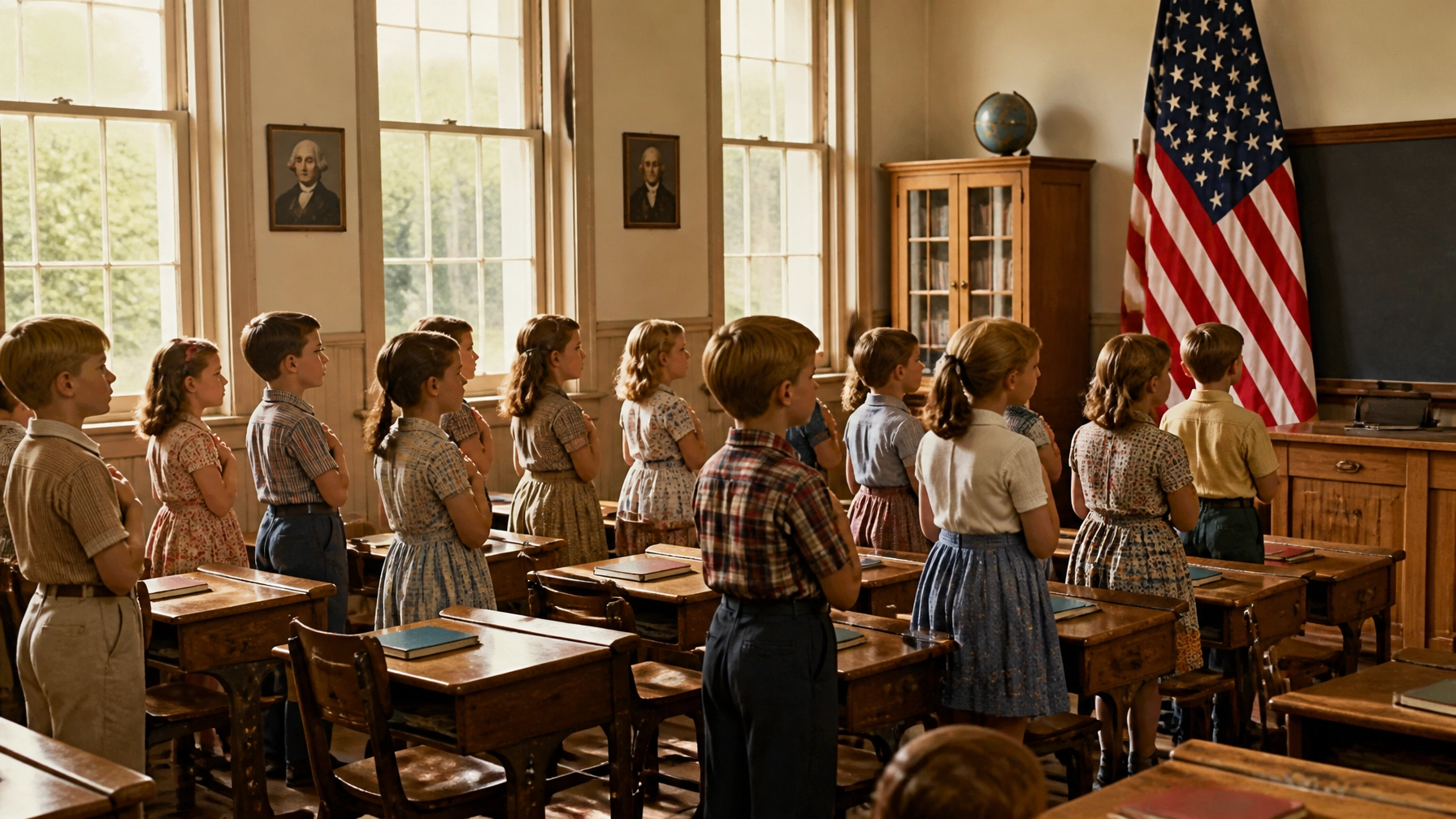
Upon signing the bill, Eisenhower declared: "From this day forward, the millions of our school children will daily proclaim in every city and town, every village and rural schoolhouse, the dedication of our nation and our people to the Almighty." It was a moment that redefined American civic life for generations to come.
7. It Transformed the Pledge into a "Civic Prayer"
Historians often point out that the 1954 change did more than just add two words; it changed the nature of the Pledge. It effectively turned a secular oath of loyalty into a hybrid of a patriotic oath and a public prayer.
This was part of a larger trend in the 1950s. This same era saw the adoption of "In God We Trust" as the official national motto (1956) and the introduction of the National Prayer Breakfast. If you're struggling to find meaningful civic content that explains these nuances, looking back at the 1950s "religious revival" in government is a great place to start.
8. The Move Was Broadly Popular at the Time
In today's climate, such a change would likely spark intense debate, but in 1954, there was virtually no public opposition in Congress. The bill passed with unanimous support. Most Americans at the time saw it as a common-sense move to bolster national morale during a time of global uncertainty.
For families and educators, this context is vital. It shows how the Pledge reflects the hopes and fears of the era in which it is spoken. Understanding this history helps us teach our children the true meaning of civic traditions as we prepare for America’s 250th anniversary.
9. You Still Can't Be Forced to Say It

Despite the official addition of "under God," the Supreme Court had already laid the groundwork for protecting those who might object. In the 1943 case West Virginia State Board of Education v. Barnette, the Court ruled that schools cannot compel students to recite the Pledge.
This is a crucial lesson in civic education. It reminds us that while the Pledge represents our collective identity, our Constitution protects the individual’s right to follow their own conscience. You can be a proud American and still value the freedom not to participate in a specific ritual.
10. The Phrase Has Survived Multiple Legal Challenges
Since 1954, there have been numerous attempts to remove "under God" from the Pledge. The most famous case was Elk Grove Unified School District v. Newdow in 2004, which reached the Supreme Court. However, the Court has consistently avoided striking the phrase down, often referring to it as "ceremonial deism": a phrase used to describe religious language that has taken on a more secular, patriotic meaning over time.
Today, the 1954 change remains firmly in place, serving as a reminder of a pivotal moment in our nation’s history. It stands as a bridge between our founding documents and the modern challenges of maintaining a unified national identity.
Why This History Matters for You

Knowing the story behind the 1954 Pledge change empowers you to engage more deeply with our national heritage. It moves the Pledge from being a rote exercise to a meaningful reflection on where we have been as a country.
Whether you are helping students understand their civic duties or reflecting on your own service as a veteran, these details matter. They remind us that the American story is always evolving: and that you are a part of it.
Ready to dive deeper into American history and civic life? Explore our offerings or join the conversation on our blog. Let’s keep the spirit of informed patriotism alive together!