
Most people think the Pledge of Allegiance is just a robotic morning routine: until they see the deep history and complex debates hidden behind those thirty-one words. If you have ever felt like your history lessons are falling flat or your family's dinner conversations lack depth, you need to see how a single sentence can spark hours of meaningful dialogue.
As we approach America’s 250th anniversary, the call for authentic civic education has never been louder. You aren't just reciting words; you are engaging with a living document that has evolved alongside the nation. Whether you are an educator looking to liven up your classroom or a parent wanting to instill a sense of purpose in your child, these discussion starters will transform a simple ritual into a powerful learning experience.
Why the Pledge is the Heart of Your Message
The Pledge of Allegiance isn't a stagnant relic. It was written in 1892 by Francis Bellamy to celebrate the 400th anniversary of Columbus's arrival: and it has changed significantly since then. Did you know the phrase "under God" wasn't added until 1954 during the Cold War? Or that the original salute looked remarkably similar to a gesture later adopted by the Nazi party, leading to our modern "hand over heart" tradition?
By peeling back these layers, you coach your students or children to look past the surface. You empower them to ask why we say what we say.

50+ Discussion Starters to Spark Civic Curiosity
To make these easy to use, we’ve broken them down into categories. Use these to Hook your audience, Address their assumptions, and Outline the path to deeper understanding.
Category 1: The Wording & Definitions
- How would you explain the word "allegiance" to a friend who has never heard it?
- What does it mean to "pledge" something rather than just "saying" it?
- If you had to replace "Republic" with a different word, what would you choose?
- What is the difference between "liberty" and "justice"? Can you have one without the other?
- Who exactly is included in "for all"? Does our history always reflect that?
- Is "indivisible" a description of what America is, or a goal for what it should be?
- What does "one nation" mean to you in a country as diverse as ours?
- How does the meaning of the Pledge change if you remove the commas?
- If you wrote a "Pledge of Allegiance" for your own family, what words would be in it?
- Why do we say "to the flag" before we say "to the Republic"?
Category 2: History & Evolution
- Why do you think Francis Bellamy chose 1892 to launch the original Pledge?
- How does adding "of the United States of America" (added in 1923) change the focus?
- During the Cold War, why would Congress feel the need to add "under God"?
- How would the Pledge sound if we still used the "Bellamy Salute" today?
- Why has the Supreme Court had to get involved in Pledge disputes so many times?
- If the Pledge was written today, what modern events might influence its wording?
- How did the experience of World War II veterans change how the country viewed the Pledge?
- What can we learn about the 1950s from the changes made to the Pledge then?
- Does knowing the history of the Pledge make you feel more or less connected to it?
- Why do you think the Pledge has survived for over 130 years while other traditions have faded?

Category 3: Rights & Responsibilities
- The Supreme Court ruled in 1943 that students can't be forced to say the Pledge. Why is that choice important?
- Is refusing to say the Pledge a form of freedom of speech?
- Does staying silent during the Pledge show disrespect, or is it a personal right?
- How do we balance "unity" with the right to disagree?
- What responsibilities come with "allegiance"?
- If someone pledges allegiance, are they promising to never criticize the government?
- How does the Pledge protect the rights of those who don't say it?
- Should the Pledge be required in all government meetings? Why or why not?
- Does the Pledge make us better citizens, or is it just a habit?
- How would you feel if you were told you had to say a pledge to a different country?
Category 4: Personal Connection & Reflection
- What is the first memory you have of saying the Pledge?
- Does your hand over your heart feel like a physical promise or just a pose?
- Do you think about the words while you say them, or are you on "autopilot"?
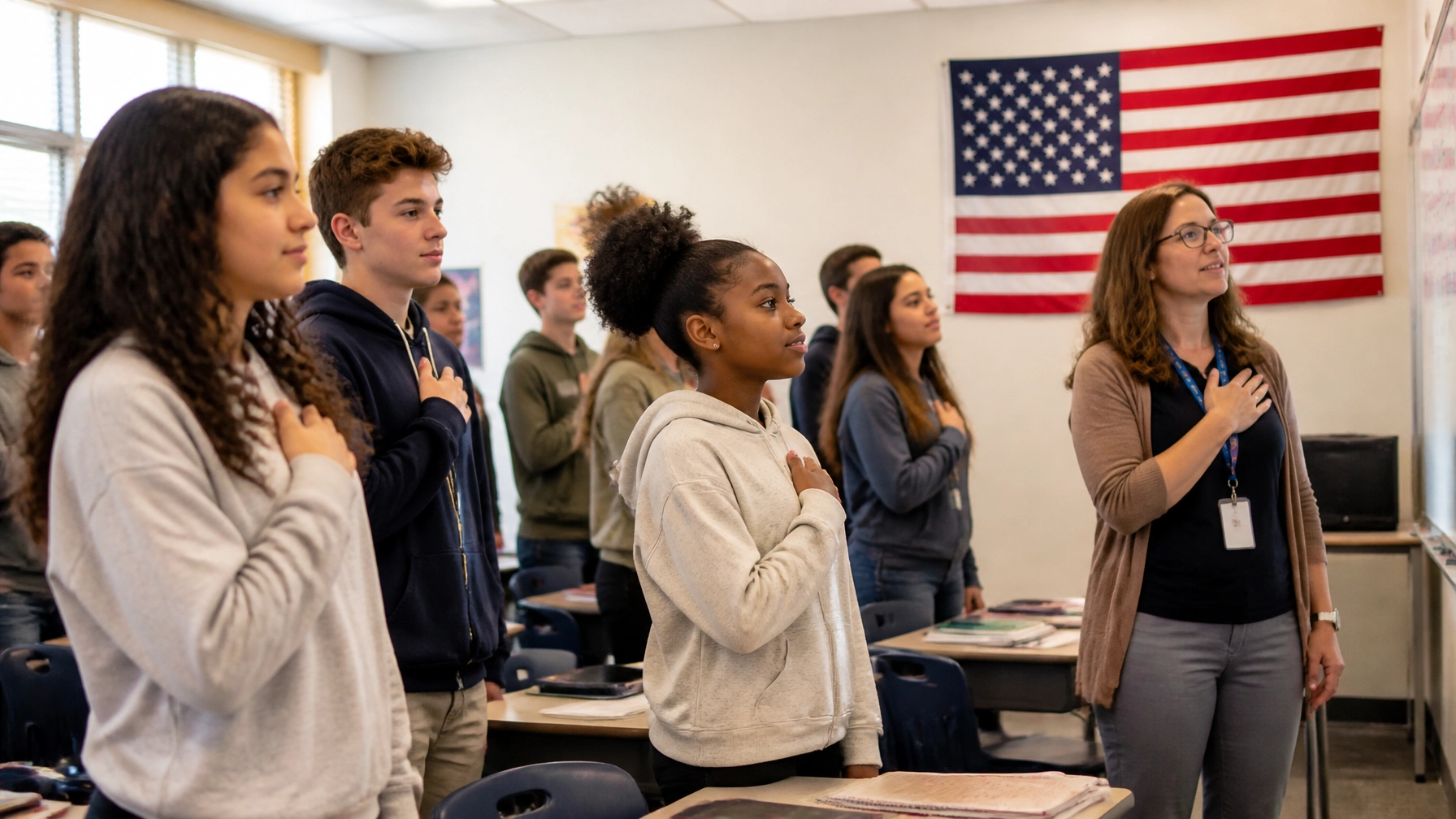
- How does the atmosphere in the room change when people stand for the Pledge?
- Does saying the Pledge make you feel like you belong to something bigger?
- If you were a veteran, how would you want students to treat the Pledge?
- How can we make the Pledge feel more meaningful in a busy school morning?
- Does your family talk about what it means to be American?
- What part of the Pledge is hardest for you to live up to?
- What part of the Pledge makes you feel the most proud?
Category 5: Looking Toward America's 250th
- How can the Pledge help unite us as we celebrate America’s 250th anniversary?
- If we could add one new phrase for the 250th, what should it be?
- How will the Pledge be viewed 50 years from now?
- How can we use the Pledge to foster "civil discourse" in our communities?
- What "injustices" in our history should we remember when we say "justice for all"?
- Does "one nation" feel more or less true today than it did 20 years ago?
- How can educators use the Pledge to teach the "checks and balances" of our Republic?
- What role do veterans play in preserving the meaning of our national symbols?
- If you had to explain the Pledge to a visitor from another planet, where would you start?
- Why is it important to keep the conversation about the Pledge alive rather than just the recitation?

Dive Deep: Bringing the Lesson to Life
Don't just read the list: implement it. If you are a teacher, try picking one "Question of the Day" each week. Lead with an action verb: Challenge your students to find the historical context of a specific word. Summarize their findings on the board.
For families, these questions are perfect for long car rides or dinner table debates. You might be surprised to find that your children have very strong opinions on what "justice" looks like in their schools. By creating a space for informed civic participation rather than divisive debate, you are doing the real work of democracy.
At Pledge Allegiance, we believe that understanding our history is the first step toward a stronger future. You can learn more about our mission and how we support veterans and schools across the nation.
Closing Thoughts: A Lasting Impression
The Pledge of Allegiance is more than a string of words: it is a mirror reflecting our nation's progress and its pain. When you use these discussion starters, you aren't just teaching history; you are coaching the next generation of leaders to think critically and love their country with their eyes wide open.
Let these questions linger in your mind. Spark a conversation today, reinforce the values of liberty and justice, and inspire a deeper connection to the Republic for which it stands.