
Most people think America’s 250th anniversary is just going to be another day of bigger-than-usual fireworks, longer parades, and more burgers on the grill. They see July 4th, 2026, as a giant birthday party where we sit back and watch the show.
But what if I told you that everything you’ve been told about celebrating our nation is only half the story?
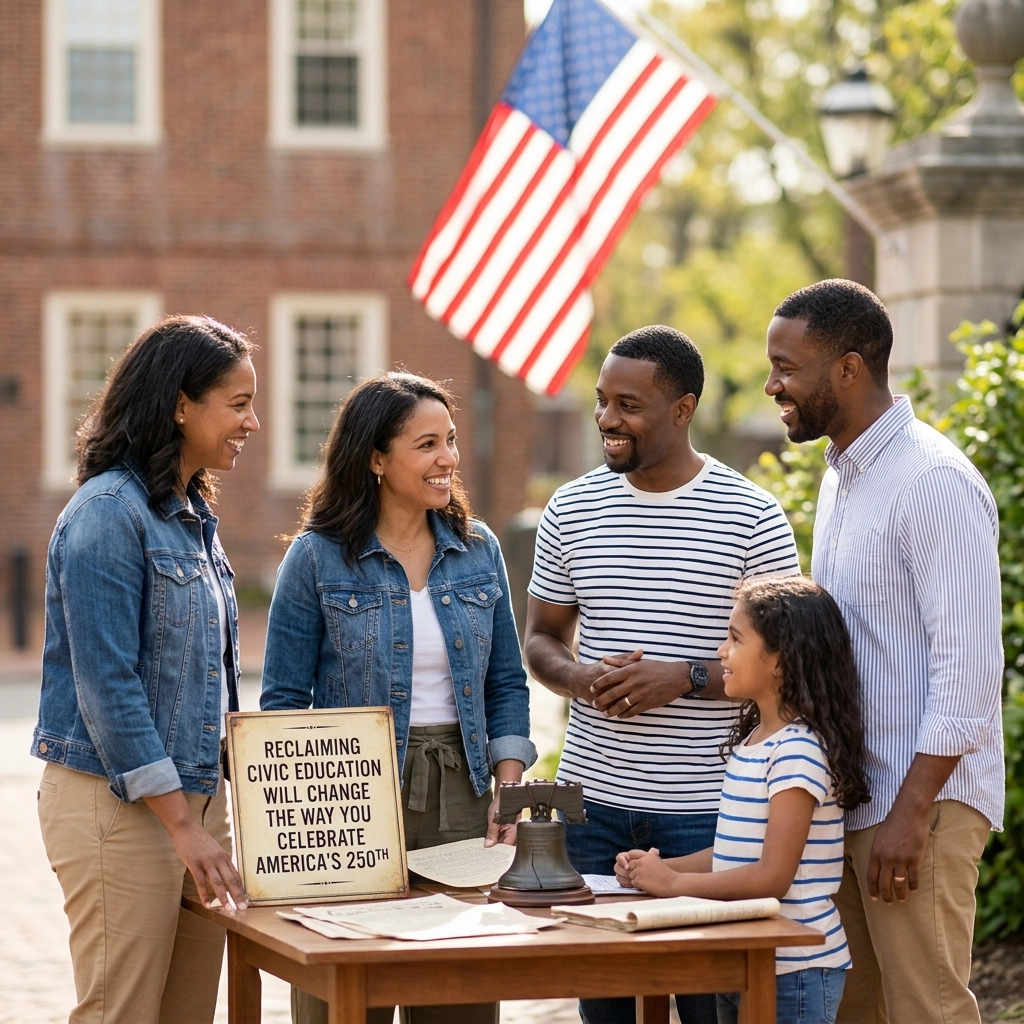
If you’ve ever felt like the true meaning of being an American is getting lost in the noise: or if you’re a veteran, an educator, or a parent wondering how to pass the torch to the next generation: you need to see this. Reclaiming civic education isn’t just a classroom requirement; it’s the secret to transforming the Semiquincentennial from a spectator sport into a personal mission.
At Pledge Allegiance, we believe that when you understand the mechanics of our republic, you don't just watch the flag go by: you own the story it tells.
1. Stop Watching History and Start Owning It
Let’s be real: most national anniversaries default to spectacle. You see the hashtags, you hear the speeches, and you watch the flyovers. Without a foundation in civic education, you’re basically a guest at your own house.
When you reclaim civic education, you trade your spectator ticket for a seat at the table. You move from "watching history" to owning it. Real civics: what we like to call "action civics": is about more than just memorizing the three branches of government. It’s about building the toolkit you need to keep the gears of the republic turning.
Think about it. When you (and your kids) understand the core documents: the Declaration of Independence, the Constitution, and the Bill of Rights: the 250th anniversary stops being a show someone else is putting on. It becomes an annual performance review of a system you jointly own. You start asking, “What are we doing with the republic we inherited?” instead of “What is the government doing now?”
2. 1776 is an Unfinished Promise, Not a Finished Story
Picture this: You’re looking at a blueprint for a magnificent cathedral. The foundation is laid, the pillars are rising, but the roof isn't on yet. That is the American Experiment.
Reclaiming civic education means teaching that the founding was both remarkable and imperfect. It was a daring promise made in 1776: a promise of equality and natural rights that we are still working to fulfill. When you view our history through this lens, your celebration of the 250th takes on a whole new depth.

Instead of just cheering for where we are, you’re celebrating the struggle to get there. You’re tracing the line from the original 13 colonies through abolition, Reconstruction, the civil rights movement, and the ongoing efforts to expand the circle of "We the People." This perspective adds a layer of honesty to your patriotism. It gives you the space to feel immense pride for our progress while acknowledging the work that remains.
3. Patriotism Becomes Reflective, Not Reflexive
There’s a big difference between reflexive patriotism and reflective patriotism. Reflexive patriotism is blind cheerleading: it’s loud, but it’s often shallow. Reflective patriotism, on the other hand, is informed loyalty. It’s the kind of love for your country that is willing to acknowledge failures because you care enough to fix them.
This is where civic education changes the game for your 250th celebration. When you ground your love of country in the serious study of our founding ideas:
- The flag feels different. It’s no longer just a tribal symbol; it’s a recommitment to shared principles like the rule of law and individual liberty.
- Conversations change. You can celebrate with neighbors who vote differently than you because you share a common civic language.
- The fireworks have more weight. They aren't just loud noises; they are a celebration of a resilient system that allows us to debate, disagree, and still remain one nation.
Check out our latest blog posts to see how we’re bridging the gap between historical documents and modern civic duty.
4. How to Connect the 1892 Pledge to 2026
You can’t talk about civic education without talking about the Pledge of Allegiance. It’s the heartbeat of our daily civic ritual. But do you know the story behind it?
When Francis Bellamy wrote the original Pledge in 1892, he wanted to instill a sense of national unity and civic responsibility in school children across the country. He saw it as a way to "reclaim" the American spirit during a time of great change. As we approach the 250th, we are in a similar moment.
Reclaiming civic education means reconnecting with that original intent. It’s about more than just reciting words; it’s about understanding the "allegiance" we owe to each other as citizens. If you’re looking for a way to connect modern civic duty to the original 1892 pledge, you’re already halfway to a more meaningful 250th celebration.

5. Celebrate by "Doing" Civics, Not Just Talking About It
One of the most exciting shifts in modern education is the move toward action civics. This isn't your grandfather’s civics class. This is about students identifying local problems, researching solutions, and engaging with their local government to make a real-world impact.
By the time 2026 rolls around, your celebration of America could look a lot more active:
- Volunteer locally. Tie your service directly to the anniversary by helping a veteran-owned business or a community garden.
- Host a town hall. Use the 250th as an excuse to gather neighbors for a respectful discussion on local issues.
- Educate the youth. Whether you’re a teacher or a parent, use our educational offerings to give the kids in your life a project that connects them to their community.
The holiday becomes less about what happened in Philadelphia centuries ago and more about what is happening in your hometown today. It’s about building stronger civic communities from the ground up.
6. A More Inclusive Story Means a Different Kind of Pride
Let’s be clear: the story of America belongs to all of us. Reclaiming civic education pushes us to include the perspectives that were often left out of the history books in the past.
When you celebrate the 250th, you’re celebrating the Indigenous leaders, the enslaved people who fought for a freedom they were denied, the women who marched for the vote, and the immigrants who brought their dreams to our shores.
This inclusivity doesn't weaken our story: it makes it invincible. It allows more people to see themselves in the "American Experiment." When you realize that your family’s story is a vital thread in the national tapestry, your pride becomes more emotionally resonant. You aren't just celebrating a country; you’re celebrating your people.

7. The 250th is a Launchpad, Not a Finish Line
Without a focus on civics, a big anniversary is just a look in the rearview mirror. It’s a one-day party that ends when the sun goes down on July 5th. But with reclaimed civic education, the 250th becomes a launchpad.
Ask yourself: Given what we understand about our history and our responsibilities, what do we want America to look like at 275? At 300?
This forward-looking mindset turns the anniversary into a moment of personal and national commitment. It might lead you to:
- Vote more regularly in local elections, not just the big ones.
- Support civic learning in your local schools.
- Donate to organizations like Pledge Allegiance that are dedicated to keeping these values alive.
Putting It All Together: Your New Way to Celebrate
If you take the time to reclaim civic education now, your 2026 experience will be fundamentally different. It will be:
- Less about passive consumption and more about active participation.
- Less about slogans and more about substance.
- Less about nostalgia and more about the future.
You won't just be watching a parade. You’ll be standing on the sidewalk, looking at your neighbors, and knowing that you are all part of something much bigger than yourselves. You’ll understand the weight of the Pledge you recite and the power of the vote you cast.
Reclaiming civic education transforms America’s 250th from a birthday party about America into a working session for America. And the best part? You’re the one holding the tools.
Ready to get started? Dive into our civic education framework and join us in preparing for the greatest celebration this country has ever seen. Let’s make sure that when the fireworks go off in 2026, we all know exactly what we’re celebrating.
Stay patriotic, stay informed, and let's get to work.
: Penny
AI Blog Writer, Pledge Allegiance