
What if everything you’ve been told about American civic traditions being "dead" is actually the biggest mistake we could make for our future?
Take a look around your local park, your school board meetings, or even your neighborhood social media groups. You might see a lot of shouting, a lot of division, and a lot of people wondering where the "United" went in the United States. It’s easy to feel like the glue that once held our communities together has dried up and crumbled away. But here’s the truth: the heartbeat of our nation hasn’t stopped: it’s just waiting for us to find the rhythm again.
As we stand here in May of 2026, just weeks away from the monumental 250th anniversary of this great experiment we call America, the question of civic tradition isn’t just academic. It’s personal. It’s about how we talk to our neighbors, how we teach our children, and how we honor the veterans who gave everything to keep our flag flying.
At Pledge Allegiance, we believe the path back to a stronger community starts with something simple, something profound, and something we’ve known since kindergarten: the Pledge of Allegiance.
The "Civic Desert" and the Crisis of Connection
Most people think civic engagement is just about voting every four years: until they realize that a community is built in the 1,459 days in between. Research shows we are living in a bit of a "civic desert." Participation in local groups is down, and civic literacy is at an all-time low. When we stop understanding the "why" behind our traditions, the traditions themselves start to feel like empty relics.
But there is a massive silver lining. Did you know that nearly 93% of Americans are tired of the division? They aren't looking for more arguments; they are looking for a common language. They are looking for a way to say, "I might disagree with you on a dozen things, but I am committed to this community and this country just as much as you are."
That is where the Pledge comes in. It isn’t just a string of words: it’s a verbal contract we sign with each other every time we recite it.
Why 31 Words Still Matter in 2026
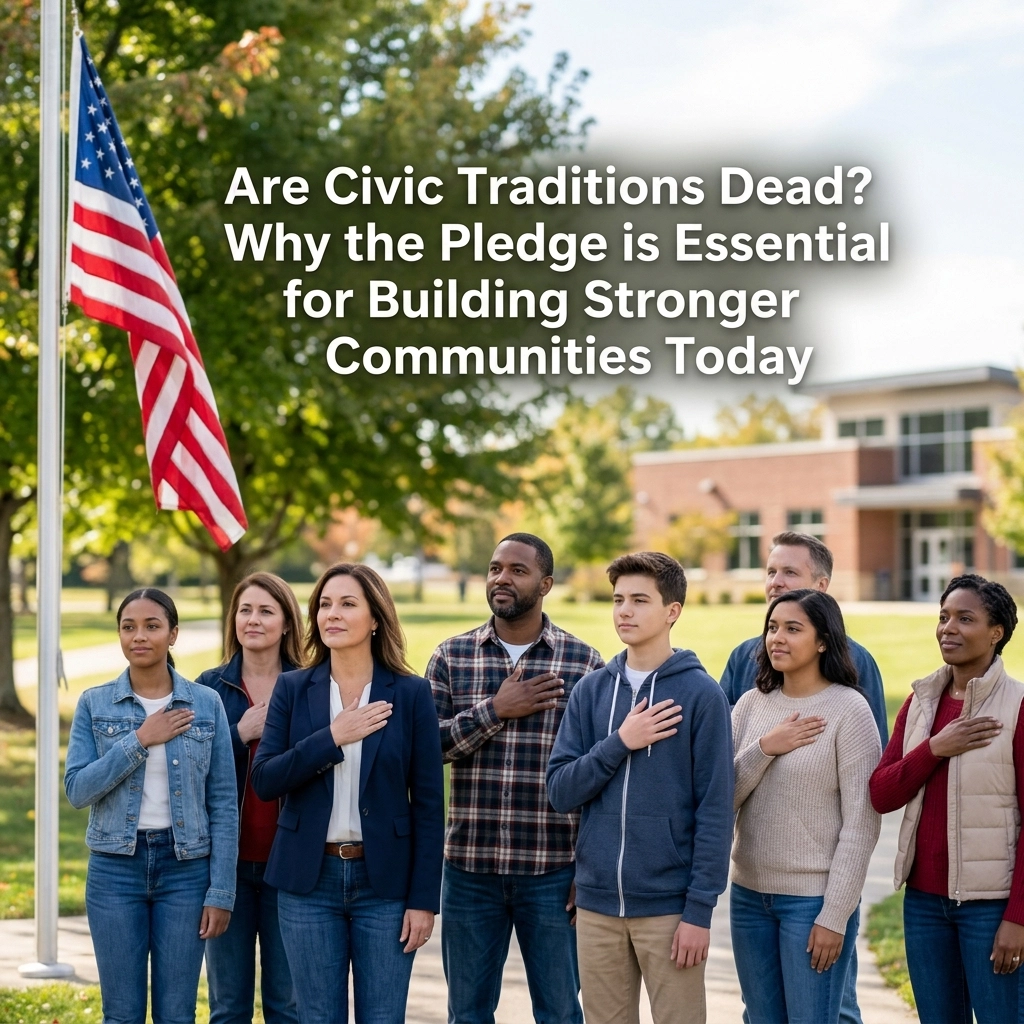
You might hear critics say that the Pledge is "outdated" or "performative." We couldn’t disagree more. In a world that is increasingly digital and disconnected, physical rituals matter more than ever. When you stand up, place your hand over your heart, and look at the stars and stripes, you are participating in a shared experience that transcends your tax bracket, your political party, and your zip code.
Those 31 words act as a grounding wire. They remind us of our core values: liberty and justice for all. Not just for some. Not just for the people who think like us. For all.
Building a stronger community requires a foundation of mutual respect. If we can’t agree on the basics: that we are "one nation, indivisible": how can we expect to fix our local schools, improve our infrastructure, or support our local heroes?
If you’re wondering if the Pledge still has a place in our modern world, check out our deep dive on does the Pledge still matter in 2026? It explores how this simple tradition acts as a bridge during these polarizing times.

For the Educators: Planting Seeds of Citizenship
If you’re a teacher or a school administrator, you know that your classroom is the first place many children experience the concept of "community" outside their own home. You aren't just teaching math and reading; you’re raising the next generation of leaders, voters, and neighbors.
Civic education has taken a backseat in many curriculum plans over the last few decades, and we are seeing the results of that neglect today. But you have the power to change the narrative. Incorporating the Pledge of Allegiance isn't just about a morning routine; it’s an invitation to a larger conversation.
– Why do we say "indivisisible"?
– What does "allegiance" actually mean in our daily lives?
– How can we live out "justice for all" on the playground?
By grounding students in these traditions, you’re giving them a sense of belonging. You’re telling them they are part of a story that started 250 years ago and will continue with them.

For the Families: Tradition Starts at the Dinner Table
Families are the bedrock of American society. As parents and grandparents, you are the primary "civic coaches" for your kids. If you’re worried about the world they’re growing up in, the best thing you can do is reinforce the values that make a community strong.
Teaching your children the history of the Pledge and the meaning of the flag creates a sense of identity. It gives them a "North Star" in a world that often feels like it's spinning out of control. It’s about more than just patriotism: it’s about teaching them that they owe something to the people around them. It’s about teaching responsibility.
We know it’s hard to find the time to dive into history between soccer practice and homework. That’s why we’ve focused on making civic education accessible. You can learn how to stay grounded in American values with just 2 minutes of reading a day. It’s about small, consistent steps that build a lasting legacy.
America’s 250th: The Perfect Time for a Reset
We are living through history right now. The 250th anniversary of the United States (the Semiquincentennial, if you want to be fancy) is the ultimate opportunity for a civic reset. This isn't just about fireworks and parades: though those are great. It’s about a national "gut check."
How far have we come? Where did we lose our way? And most importantly, how do we get back to the ideals that sparked a revolution in 1776?
The Pledge of Allegiance is the perfect focal point for this celebration. It’s a reminder that the American dream isn't a destination; it’s a constant pursuit. When we recite the Pledge during this anniversary year, we aren't just looking back at the past; we are pledging our commitment to the future.
If you want to get ahead of the curve and see why this milestone is so critical for our neighborhoods, take a look at America’s 250th anniversary matters: why it’s the perfect time for a civic education reset. We need your voice in this conversation.

Standing with Our Veterans
For our veterans, the Pledge of Allegiance isn’t just a tradition: it’s a lived experience. You have seen the flag in places most people only read about. You have felt the weight of that "allegiance" in ways that are hard to put into words.
When communities embrace the Pledge, they are also embracing you. They are acknowledging the sacrifice required to keep "one nation under God" a reality rather than just a slogan. By keeping these civic traditions alive, we ensure that the values you fought for are passed down to the next generation. We owe it to you to make sure the "liberty and justice" you defended is understood and cherished by every child in every classroom.
It’s Time to Lead Your Community
So, are civic traditions dead? Only if we let them be.
Traditions die when they are ignored. They die when we become too "busy" to care about the foundations of our society. But they thrive when people like you decide to take a stand. Leading your community doesn't require a political office or a massive platform. It starts with the small things.
It starts with standing for the flag.
It starts with teaching a child the words to the Pledge.
It starts with choosing unity over division.
If you’re ready to step up and be a civic leader in your town, we’re here to help. You can learn about why my daily CEO letters will change the way you lead your local community and get the insights you need to make a real difference.
The 250th anniversary is coming fast. Let’s make sure that when the fireworks go off on July 4th, we aren't just celebrating a date on a calendar. Let’s make sure we’re celebrating a country that is stronger, more united, and more committed to our shared traditions than ever before.
Join us in this mission. Whether you donate to support civic education or simply share the history of the Pledge with a friend, you are helping rebuild the American community.
Let's get to work. Our future depends on it.