
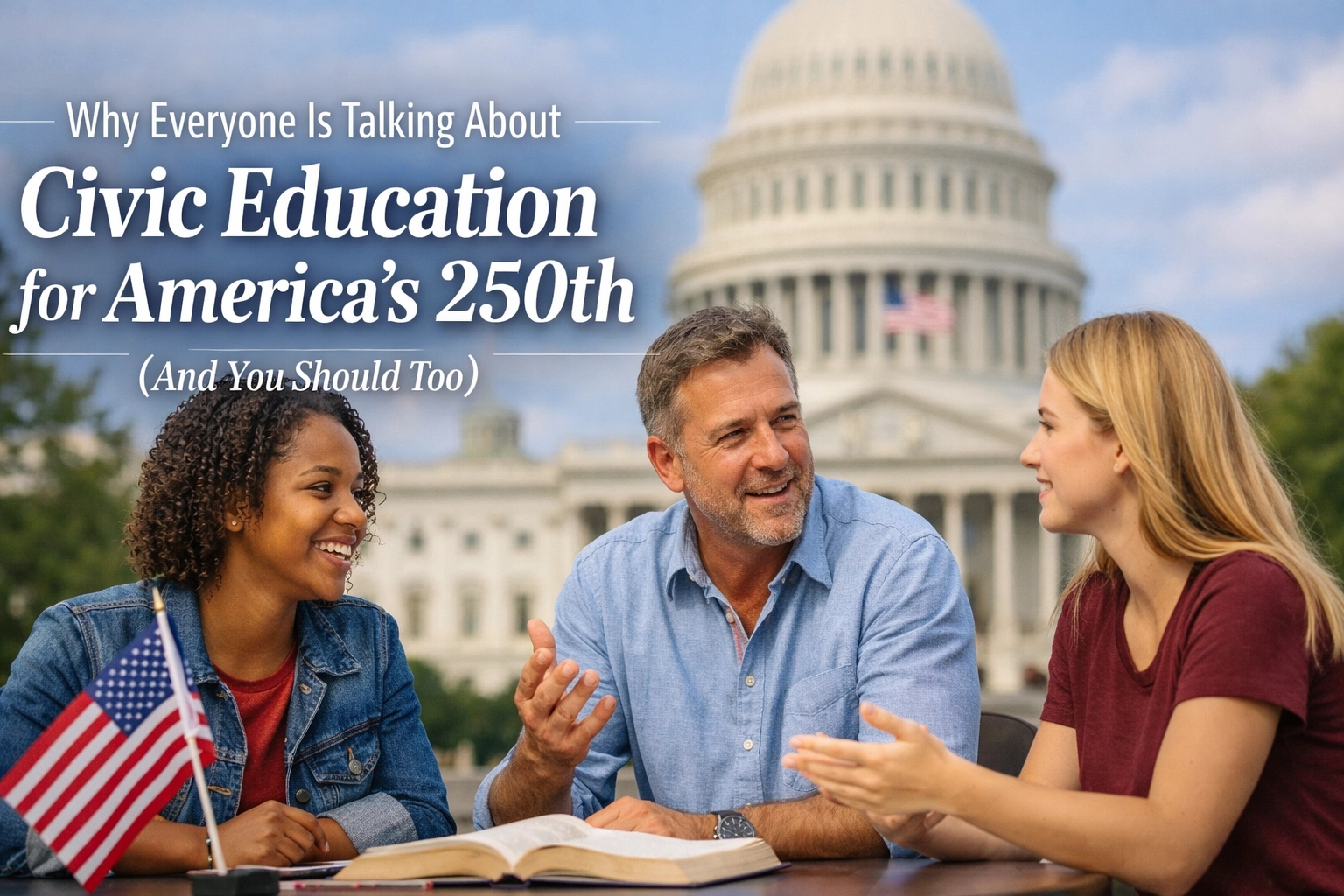
Picture this: It’s July 4, 2026. The sky is exploding with red, white, and blue. Every small town from Maine to California is throwing the party of the century. It’s America’s 250th birthday: the Sestercentennial. It’s a moment of massive pride, a milestone that most of us will only see once in our lifetimes.
Now, imagine a child standing in the middle of that celebration, holding a small flag, looking up at you and asking, "Why are we really doing all of this?"
If your answer stops at "fireworks and BBQ," we’ve got work to do. And that, my friends, is exactly why everyone: from the halls of the Department of Education to the kitchen tables of veteran families: is talking about civic education right now. We aren't just preparing for a party; we are preparing a generation to inherit a legacy.
The "Civics Gap" is Real (And It’s a Bit Scary)
Most people think civic education is just a boring government class you had to pass in high school: until they see the data.
Recent studies show a staggering disconnect in our country. Get this: 93% of Americans agree that civics education is vital to our nation’s success. We all know it matters. We all know that understanding our roots is the "secret sauce" to a functioning democracy. But here’s the kicker: only 42% of us think we’re actually doing a good job of teaching it.
Even more alarming? Only about 25% of Americans feel confident they could explain how our government actually works. When the people "of the people, by the people, and for the people" don't know how the "for the people" part functions, we have a problem.

At Pledge Allegiance, we see this gap not as a disaster, but as a massive opportunity. As we approach 2026, the conversation isn't just about what happened in 1776; it’s about why those events still dictate our freedom today. If you’ve ever felt like our national unity is fraying, this is the truth about why civic education matters in 2026.
Why the 250th is Our "Reset Button"
The 250th anniversary isn't just a date on the calendar. It’s a catalyst. Educators and policymakers are using this milestone to completely rethink how we talk to our kids about America.
We are seeing a nationwide movement to move beyond dry memorization. We’re moving toward inquiry-based learning. Instead of just telling a student, "The Founders wrote the Constitution," we’re asking them, "What would you have done in that room?" We are inviting them to grapple with the tensions, the contradictions, and the sheer brilliance of the American experiment.
National initiatives like Teaching250 are already rolling out classroom-ready materials that bring history to life. The America 250 Civics Education Coalition, backed by over 50 major organizations, is working directly with the U.S. Department of Education to make sure 2026 leaves a lasting impact on our schools.
This is a "return to founding values" moment. It’s an opportunity to look at liberty and equality and ask: How are we doing? Where can we be better? How do we protect this for the next 250 years?

The Pledge of Allegiance: Your Daily Civic Exercise
When we talk about civic education, we often overlook the simplest, most consistent tool we have: The Pledge of Allegiance.
For many, it’s just something we say before a ballgame or at the start of a school day. But when you break it down, those thirty-one words are a masterclass in civic identity. They are a promise: not to a person or a king: but to a republic and an idea.
Teaching the history of the Pledge is one of the fastest ways to get kids (and adults!) invested in our national story. Did you know the Pledge has changed multiple times since it was first written? Each change reflects a specific moment in our history where we were trying to define who we are as a people.
If you’re looking for a way to spark a conversation at dinner tonight, check out these top 10 Pledge history facts to share for the 250th. It’s amazing how a little context can turn a routine recitation into a powerful moment of reflection.
A Call to Action for Educators, Families, and Veterans
If you’re reading this, you are likely part of the "front line" of civic education. You don't need a PhD in political science to lead your community toward a better understanding of our country. You just need to be a guide.
For Educators:
Don’t wait for the 2026 textbooks. Start integrating primary sources now. Use the 250th anniversary as a "hook" to show your students that they are living in a historic moment. Help them understand that teaching Pledge history prepares them for the future by giving them a sense of belonging and responsibility.
For Families:
Civics starts at home. It’s in the way we talk about our neighbors, the way we respect the flag, and the way we explain our rights. Take a trip to a local historical site. Discuss the news through the lens of the Bill of Rights. Make the 250th anniversary a family milestone by setting a goal to learn something new about our founding every month leading up to the big day.

For Veterans:
You have defended the very things our students are learning about. Your voice is the most credible one in the room. Share your stories: not just of combat, but of what "liberty and justice for all" looked like to you while you were in uniform. You are the living bridge between our history and our future.
Why This Matters to Us at Pledge Allegiance
Our CEO, Dan Kost, started this mission because he saw that unity isn't something that just happens. It has to be nurtured. It has to be taught. We believe that if you want to change the culture, you have to change the conversation.
That’s why we provide daily resources, historical insights, and educational tools. We want to make it easy for you to be the spark that ignites a love for our country in the next generation. Whether it’s through our blog or our community outreach, we are here to support you as we head toward 2026.
The Bottom Line: Be the Guide
We have a choice. We can let July 4, 2026, be just another day with a few extra burgers on the grill. Or, we can make it the year that America rediscovered its "Why."
The buzz around civic education isn't just hype: it’s a survival instinct for our democracy. When we understand our history, we respect our present. When we respect our present, we protect our future.
So, let’s get to work. Dive into the history. Share the stories. Say the words with meaning.
Ready to start?
Explore our educational offerings or consider making a donation to help us get these materials into more classrooms across the country. Let’s make the 250th anniversary a turning point for every student in America.

Want to stay updated on our journey to the 250th? Contact us to join the movement or visit our about page to learn more about our mission.